Wine has interested me for a while. The way it has begun to impact and grow in cultural relevance is curious to me. I don't claim to be an expert, but I am fascinated by this "living, breathing thing. Constantly able to change and gain complexity." That quote is from the movie Sideways (2004). The movie follows a wine Conessiur, Milo, and his friend on a tour of wine country. It touches on some cultural issues that surround wine drinking and the wine community. The movie alone may have caused an increase of 147% in sales of Pinot Noir, the movie's unofficial star.
Wine is also a business. Last year, the Californian wine industry was estimated to be worth $45.4 billion. Traditionally an old world specialty, wine has increasingly become more popular in America and so has its production. America, Australia, and South America have really begun to see sales of their wines take off. While in France, the government had to bail out their wine industry last year. And America is also the largest consumer of wines in the world.
Another film, Mondovino (2005) explores the differences between small wineries and large companies such as Mondavi and EJ Gallo. It interviews small vintners and they claim that the wine industry is falling apart and that there is no personality left in wine. Large companies are happy with their sales and strive to increase their market share. The movie explores the idea of terroir, literally "soil" in French, but has increased in meaning to the taste that an agricultural product takes on based on where it is located. The small wineries claim that they have a rightful claim to terroir and that is what produces the tastes of a Burgundy or Bordeaux. Large companies use technology to make up for their lack of geographic location. Mondavi and Rothchild for example, add new oak to their production process to add flavor to their wines.
An article in the Economist points out another issue affecting the wine industry. In California, grapes are able to grow larger and contain more sugar. When fermentation takes place, this causes more alcohol to be produced, which generally does not taste good in a wine. Some wineries in California are adding water to their batches in order to "mellow" the alcohol content. Most of the wine world frowns upon this practice, but consumers might not tell the difference, and it is wondered if they even care.
Wine is also sometimes seen as an investment. You can buy a good bottle of wine, place it in a safe location for a few years and then sell it at a higher price. While I don't know much about this process, it intrigues me and I have posted some websites that explain more about the differences of wine.
The Internet Wine Guide
A Guide to French Wines
A Guide to Italian Wines
Check out the above sites and go out and enjoy the world of wine!
Friday, October 07, 2005


Thursday, October 06, 2005
Manufacturing Jobs Disappearing: That's a Good Thing!
This article from the Economist calls attention to the high number of manufacturing jobs disappearing in highly-developed, richer countries.
It suggests that less than 10% of jobs in America are of the manufacturing variety, yet America still leads the world in manufacturing (by dollar amount). This gets to the heart of an observation and its implications.
The article implies that manufacturing in richer countries is inefficient. Change is a good thing and those economies are changing toward more service-oriented economies. R&D, marketing, and management are becomming the strong points of the American economy. Putting together shoes or cars is left to economies that may have an edge on wages, but don't necessarily have an edge on inovation.
With respects to the common worry about China taking everyone's jobs the article has this to say:
The Economist article illustrates this point at the closing:
It suggests that less than 10% of jobs in America are of the manufacturing variety, yet America still leads the world in manufacturing (by dollar amount). This gets to the heart of an observation and its implications.
The article implies that manufacturing in richer countries is inefficient. Change is a good thing and those economies are changing toward more service-oriented economies. R&D, marketing, and management are becomming the strong points of the American economy. Putting together shoes or cars is left to economies that may have an edge on wages, but don't necessarily have an edge on inovation.
With respects to the common worry about China taking everyone's jobs the article has this to say:
a basic principle of economics, proven time and again, is that even if a country can make everything more cheaply, it will still gain from specialising in goods in which it has a comparative advantage. Developed economies' comparative advantage is in knowledge-intensive activities, because they have so much skilled labour. For years to come, China will be more likely to assemble the best computers than to design them.Tom Peters, a management guru, in the book Re-Imagine! talks about a white-collar chateclism, which will change all our jobs forever. He forsees a world where companies are no longer eternal entities. People will come together with a good idea, produce the idea, and when the idea is beaten by another or becomes obsolete the "temporary company" will disolve and those workers will move on to other projects. His point is that business and the world change. It is up to us to change with it.
The Economist article illustrates this point at the closing:
People always resist change, yet sustained growth relies on a continuous shift in resources to more efficient use. In 1820, for example, 70% of American workers were in agriculture; today 2% are. If all those workers had remained tilling the land, America would now be a lot poorer.
Municipal Power Utility in Iowa City?
Iowa City will be voting on the following two questions on November 8th:
Shall the City of Iowa City in the County of Johnson, Iowa, be authorized to establish as a city utility and power plant and system?
and
Shall the management and control of an electric light and power plant city utility be placed in a board of trustees consisting of five trustees as provided by law?
The reason this vote is being put to the people is because a certain group perceives our utilities prices as being too high in Iowa City. I've linked to some sites below that cover a range of opinions on this issue:
MidAmericanEnergy
Press-Citizen OpEd piece about the confusing wording of the ballot.
An Iowa City Law Professor talking about the implications of a "yes" vote (and favoring one).
A letter refuting the above letter.
Citizens for Public Power website. I encourage you to check the "Reasons to Vote Yes" section and the "What people you know and trust say" section.
Finally, a letter to the editor from a candidate for the Iowa City council.
Personally, I agree with the final letter. I like the points he makes about not all communities using public power have rates lower than Iowa City. A significant number have higher rates.
I also do not like the idea of a municipality claiming to be able to run something better than the private sector. Often times, people believe when the government steps in to run things, all their troubles and cares will disappear. A brief glance at the State and Federal government's handling of the Katrina disaster should snap them back to reality. Bureaucracy and delay is all they know how to do well.
The article by Rick Dobyns rightfully points out that to purchase the energy from a co-op or from an energy broker, the citizens will have to pay for it (in this case with bonds sold to make the purchase. Hopefully, the income from the public utility will meet the costs of interest and principle, while allowing the energy rates to stay lower). The power wholesalers are not going to give Iowa City power for free, just because we've taken a more "progressive" view of distribution.
Another fact Rick points out is the almost $100 million discrepancy between both camp's cost estimates for acquiring MidAmerican's distribution means. The "Yes" group says Iowa City will save $60 million dollars and the "No" group says the city will lose $58 million. This is just too large a gap between estimates, leading me to believe that neither is true.
A neighbor of mine is a strong advocate for the "yes" vote. She came around and knocked on our neighborhood's doors trying to gain support for the two initiatives. I told her I was leaning toward voting "no." She explained that MidAmerican Energy has a 12% profit margin and that was too high. She also said that we shouldn't trust a large company.
Had she let me get a word in edgewise, I would have replied that profits for a company are good and that even she could participate in those profits by purchasing stock in Berkshire Hathaway or even the company itself. Those profits aren't just squandered. They are reinvested in the infrastructure and used to fund R&D in order to provide more efficient and cost-effective ways to continue to deliver power.
By the way, I'm sick of people demonizing large companies. See my post about Wal-mart for more in-depth opinion on the issue, but it is because of these large companies that we are able to live the lifestyles we do. These companies are able to deliver to consumers what they want or need. Yes, they do it for profit. But only the foolish, shortlived companies would not use that profit to seek better ways of "delivering the goods." I'm not naive. I know about Enron and Worldcom, but please, these examples are few and far between when taken in the context of the number of capitalistic and entrepreneurial companies in America.
I'm still keeping an open mind and reading the local papers and talking to friends, but as of today, I'm probably going to vote "no."
Shall the City of Iowa City in the County of Johnson, Iowa, be authorized to establish as a city utility and power plant and system?
and
Shall the management and control of an electric light and power plant city utility be placed in a board of trustees consisting of five trustees as provided by law?
The reason this vote is being put to the people is because a certain group perceives our utilities prices as being too high in Iowa City. I've linked to some sites below that cover a range of opinions on this issue:
MidAmericanEnergy
Press-Citizen OpEd piece about the confusing wording of the ballot.
An Iowa City Law Professor talking about the implications of a "yes" vote (and favoring one).
A letter refuting the above letter.
Citizens for Public Power website. I encourage you to check the "Reasons to Vote Yes" section and the "What people you know and trust say" section.
Finally, a letter to the editor from a candidate for the Iowa City council.
Personally, I agree with the final letter. I like the points he makes about not all communities using public power have rates lower than Iowa City. A significant number have higher rates.
I also do not like the idea of a municipality claiming to be able to run something better than the private sector. Often times, people believe when the government steps in to run things, all their troubles and cares will disappear. A brief glance at the State and Federal government's handling of the Katrina disaster should snap them back to reality. Bureaucracy and delay is all they know how to do well.
The article by Rick Dobyns rightfully points out that to purchase the energy from a co-op or from an energy broker, the citizens will have to pay for it (in this case with bonds sold to make the purchase. Hopefully, the income from the public utility will meet the costs of interest and principle, while allowing the energy rates to stay lower). The power wholesalers are not going to give Iowa City power for free, just because we've taken a more "progressive" view of distribution.
Another fact Rick points out is the almost $100 million discrepancy between both camp's cost estimates for acquiring MidAmerican's distribution means. The "Yes" group says Iowa City will save $60 million dollars and the "No" group says the city will lose $58 million. This is just too large a gap between estimates, leading me to believe that neither is true.
A neighbor of mine is a strong advocate for the "yes" vote. She came around and knocked on our neighborhood's doors trying to gain support for the two initiatives. I told her I was leaning toward voting "no." She explained that MidAmerican Energy has a 12% profit margin and that was too high. She also said that we shouldn't trust a large company.
Had she let me get a word in edgewise, I would have replied that profits for a company are good and that even she could participate in those profits by purchasing stock in Berkshire Hathaway or even the company itself. Those profits aren't just squandered. They are reinvested in the infrastructure and used to fund R&D in order to provide more efficient and cost-effective ways to continue to deliver power.
By the way, I'm sick of people demonizing large companies. See my post about Wal-mart for more in-depth opinion on the issue, but it is because of these large companies that we are able to live the lifestyles we do. These companies are able to deliver to consumers what they want or need. Yes, they do it for profit. But only the foolish, shortlived companies would not use that profit to seek better ways of "delivering the goods." I'm not naive. I know about Enron and Worldcom, but please, these examples are few and far between when taken in the context of the number of capitalistic and entrepreneurial companies in America.
I'm still keeping an open mind and reading the local papers and talking to friends, but as of today, I'm probably going to vote "no."
Wednesday, October 05, 2005
The Economic Pulse of the Country
The Congressional Budget Office last week released a summary of economic indicators in the United States. Check it out here. Especially interesting is the unemployment rate and the number of new jobs created over the last two years.
Devils on the Deep Blue Seas
I read an article about the true financial windfall that Katrina enabled the Cruise industry to collect on. The federal government is leasing the three ships from Carnival to aid in the relief and rebuilding effort for Katrina. From Carinval's perspective, the money is just making up for the lost profits.
This reminded me of an interesting report from "The World" on NPR I heard about the way a cruise ship is run. The number of crew on a cruise is amazing. Cruises are also highly diverse. The report comes with a Marxist slant, but it is interesting nonetheless. I'd love to hear your perspective.
This reminded me of an interesting report from "The World" on NPR I heard about the way a cruise ship is run. The number of crew on a cruise is amazing. Cruises are also highly diverse. The report comes with a Marxist slant, but it is interesting nonetheless. I'd love to hear your perspective.
Avian Flu epidemic
I don't want to scare anyone, and this may be a bit off topic for the blog, but I thought I would post some links to articles about the H5N1 flu virus. It is transferred to humans from ducks and has already killed a number of people in Southeast Asia. So far it is not made the mutation to be able to transfer from human to human, but as most viruses do mutate constantly, many people think that time may not be far off.
This virus has a high death rate (over 50%) and the symptoms are similar to pneumonia. Scientists have been studying the virus and have been unable to create a vaccine for it. They have, however, identified a medicine which has a high success rate at treating the symptoms. The drug is called Tamiflu and is manufactured by only one company in the world: Rosche.
A number of news sites have posted articles about the potential economic and physical devastation a human outbreak could cause. ABC news ran a report on Primetime about the virus. Prudent people will prepare accordingly, possibly acquiring a Tamiflu regimen and preparing for possible social unrest and disruption of daily life.
Here are some articles:
CDC website
AP News article about U.S. potential response (not enough, in my opinion)
Council on Foreign Affairs article
Asian Times article
CNN website
This virus has a high death rate (over 50%) and the symptoms are similar to pneumonia. Scientists have been studying the virus and have been unable to create a vaccine for it. They have, however, identified a medicine which has a high success rate at treating the symptoms. The drug is called Tamiflu and is manufactured by only one company in the world: Rosche.
A number of news sites have posted articles about the potential economic and physical devastation a human outbreak could cause. ABC news ran a report on Primetime about the virus. Prudent people will prepare accordingly, possibly acquiring a Tamiflu regimen and preparing for possible social unrest and disruption of daily life.
Here are some articles:
CDC website
AP News article about U.S. potential response (not enough, in my opinion)
Council on Foreign Affairs article
Asian Times article
CNN website
Financial Aid for Casinos
Financial aid for casinos in New Orleans? The below email was copied me by a friend. I tend to agree with it. However, casinos are businesses too, and they weren't spared the wrath of Katrina. What do you think?
Please forward this to Representative Lewis:
Dear Mr. Lewis: I petition you to join with Rep. Frank Wolf of Virginia in opposing the half-billion dollar tax credit for the casinos on the Gulf Coast included in the GO Zone legislation. Government has avoided giving tax aid to the gambling industry in the past, and they should continue to do so. This is a misuse of tax money, especially in light of the fact that the casinos didn’t even ask for it!
Please support legislation that will put the money toward reconstructing the infrastructure, not toward a group of financially robust giants whose industry is known to increase crime rates and poverty within any society in which it is introduced. If indeed this is true, and there are many studies that show it is, then casinos actually exacerbated the problems caused by Katrina because many of those who did not leave the region didn’t do so because of financial woes probably indirectly or directly caused by casino industry.
This is an important issue for me and my family. Thank you for your time and I look forward to hearing from you.
Wednesday, August 31, 2005
Ayn Rand's Philosophy on Money: Not the Root of All Evil
As promised an expert from "Atlas Shrugged" by Ayn Rand. Here the character Francisco D'Anconia is explaining the value of money and where that value comes from to guests at a dinner party, who are saying that money is the "Root of all Evil."
Let me know what you think of the above passage by leaving a comment below.
Pretty powerful view of economic theory and the value of people in relation to money, no? The above expert comes from pp 411-414 of Atlas Shrugged. A good book, in my opinion.
"So you think that money is the root of all evil?" said Francisco D'Anconia. "Have you ever asked what is the root of money? Money is a tool of exchange, which can't exist unless there are goods produced and men able to produce them. Money is the material shape of the principle that men who wish to deal with one another must deal by trade and give value for value. Money is not the tool of the looters, who take it from you by force. Money is made possible only by the men who produce. Is this what you consider evil?
"When you accept money in payment for your effort, you do so only on the conviction that you will exchange it for the product of the effort of others. It is not the moochers or the looters who give value to money. Not an ocean of tears nor all the guns in the world can transform those pieces of paper in your wallet into the bread you will need to survive tomorrow. Those pieces of paper, which should have been gold, are a token of honor - your claim upon the energy of the men who produce. Your wallet is your statement of hope that somewhere in the world around you there are men who will not default on that moral principle which is the root of money. Is this what you consider evil?
"Have you ever looked for the root of production? Take a look at an electric generator and dare tell yourself that it was created by the muscular effort of unthinking brutes. Try to grow a seed of wheat without the knowledge left to you by men who had to discover it for the first time. Try to obtain your food by means of nothing but physical motions - and you'll learn that man's mind is the root of all the goods produced and of all the wealth that has ever existed on earth.
"But you say that money is made by the strong at the expense of the weak? What strength do you mean? It is not the strength of guns or muscles. Wealth is the product of man's capacity to think. Then is money made by the man who invents a motor at the expense of those who did not invent it? Is money made by the intelligent at the expense of the fools? By the able at the expense of the incompetent? By the ambitious at the expense of the lazy? Money is made - before it can be looted or mooched - made by the effort of every honest man, each to the extent of his ability. An honest man is one who knows that he can't consume more than he has produced.
"To trade by means of money is the code of the men of good will. Money rests on the axiom that every man is the owner of his mind and his effort. Money allows no power to prescribe the value of you effort except the voluntary choice of the man who is willing to trade you his effort in return. Money permits you to obtain for your goods and your labor that which they are worth to the men who buy them, but no more. Money permits no deals except those to mutual benefit, not for their own injury, for their gain, not for their loss - the recognition that they are not beasts of burden, born to carry the weight of your misery - that you must offer them values, not wounds - that the common bond among men is not the exchange of suffering, but the exchange of goods. Money demands that you sell, not your weakness to men's stupidity, but your talent to their reason; it demands that you buy, not the shoddiest they offer, but the best that your money can find. And when men live by trade - with reason, not force, as their final arbiter - it is the best product that wins, the best performance, the man of best judgment and highest ability - and the degree of man's productiveness is the degree of his reward. This is the code of existence whose tool and symbol is money. Is this what you consider evil?
"But money is only a tool. It will take you wherever you wish, but it will not replace you as the driver. It will give you the means for the satisfaction of your desires, but it will not provide you with desires. Money is the scourge of the men who attempt to reverse the law of causality - the men who seek to replace the mind by seizing the products of the mind.
"Money will not purchase happiness for the man who has no concept of what he wants: money will not give him a code of values, if he's evaded the knowledge of what to value, and it will not provide him with a purpose, if he's evaded the choice of what to seek. Money will not buy intelligence for the fool, or admiration for the coward, or respect for the incompetent. The man who attempts to purchase the brains of his superiors to serve him, with his money replacing his judgment, ends up by becoming the victim of his inferiors. The men of intelligence desert him, but the cheats and the frauds come flocking to him, drawn by a law which he has not discovered: that no man may be smaller than his money. Is this the reason you call it evil?
"Only the man who does not need it, is fit to inherit wealth - the man who would make his own fortune no matter where he started. If an heir is equal to his money, it serves him; if not, it destroys him. But you look on and you cry that money corrupted him. Did it? Or did he corrupt his money? Do not envy a worthless heir; his wealth is not yours and you would have done no better with it. Do not think that it should have been distributed among you; loading the world with fifty parasites instead of one, would not bring back the dead virtue which was the fortune. Money is a living power that dies without its root. Money will not serve the mind that cannot match it. Is this the reason you call it evil?
"Money is your means of survival. The verdict you pronounce upon the source of your livelihood is the verdict you pronounce upon your life. If the source is corrupt, you have damned your own existence. Did you get your money by fraud? By pandering to men's vices or men's stupidity? By catering to fools, in the hope that getting more than your ability deserves? By lowering your standards? By doing work you despise for purchasers you scorn? If so, then your money will not give you a moment's or a penny's worth of joy. Then all the things you buy will become, not a tribute to you, but a reproach; not an achievement, but a reminder of shame. Then you'll scream that money is evil. Evil, because it would not pinch-hit for your self-respect? Evil, because it would not let you enjoy your depravity? Is this the root of hatred of money?
"Money will always remain an effect and refuse to replace you as the cause. Money is the product of virtue, but it will not give you the unearned, neither in matter nor in spirit. Is this the root of your hatred of money?
"Let me give you a tip on a clue to men's characters: the man who damns money has obtained it dishonorable; the man who respects it has earned it.
"Run for your life from any man who tells you that money is evil. That sentence is the leper's bell of an approaching looter. So long as men live together on earth and need means to deal with one another - their only substitute, if they abandon money, is the muzzle of a gun.
"But money demands of you the highest virtues, if you wish to make it or to keep it. Men who have no courage, pride or self-esteem, men who have no moral sense of their right to their money and are not willing to defend it as they defend their life, men who apologize for being rich - will not remain rich for long. They are the natural bait for the swarms of looters that stay under rocks for centuries, but come crawling out at the first smell of a man who begs to be forgiven for the guilt of owning wealth. They will hasten to relieve him of the guilt - and of his life, as he deserves.
"Watch money. Money is the barometer of a society's virtue. When you see that trading is done, not by consent, but by compulsion - when you see that in order to produce, you need to obtain permission from men who produce nothing - when you see that money is flowing to those who deal, not in goods, but in favors - when you see that men get richer by graft and by pull than by work, and your laws don't protect you against them, but protect them against you - when you see corruption being rewarded and honesty becoming a self-sacrifice - you may know that your society is doomed. Money is so noble a medium that it does not compete with guns and it does not make terms with brutality. It will not permit a country to survive as half-property, half-loot.
"Whenever destroyers appear among men, they start by destroying money, for money is men's protection and the base of a moral existence. Destroyers seize gold and leave to its owners a counterfeit pile of paper. This kills all objective standards and delivers men into the arbitrary power of an arbitrary setter of values. Gold was an objective value, an equivalent of wealth produced. Paper is a mortgage on wealth that does not exist, backed by a gun aimed at those who are expected to produce it. Paper is a check drawn by legal looters upon an account which is not theirs: upon the virtue of the victims. Watch for the day when it bounces, marked: 'Account Overdrawn.'
"When you have made evil the means of survival, do not expect men to remain good. Do not expect them to stay moral and lose their lives for the purpose of becoming the fodder of the immoral. Do not expect them to produce, when production is punished and looting rewarded. Do not ask, 'Who is destroying the world?' You are.
"... Throughout men's history, money was always seized by looters of one brand or another, whose names changed, but whose method remained the same: to seize wealth by force and to keep the producers bound, demeaned, defamed, deprived of honor. That phrase about evil of money, which you mouth with such righteous recklessness, comes from a time when wealth was produced by the labor of slaves - slaves who repeated the motions once discovered by somebody's mind and left unimproved for centuries. So long as production was ruled by force, and wealth was obtained by conquest, there was little to conquer. Yet through all the centuries of stagnation and starvation, men exalted the looters, as aristocrats of the sword, as aristocrats of birth, as aristocrats of the bureau, and despised the producers, as slaves, as traders, as shopkeepers - as industrialists.
"To the glory of mankind, there was, for the first and only time in history, a country of money - and I have no higher, more reverent tribute to pay to America, for this means: a country of reason, justice, freedom, production, achievement. For the first time, man's mind and money were set free, and there were no fortunes-by-conquest, but only fortunes-by-work, and instead of swordsmen and slaves, there appeared the real maker of wealth, the greatest worker, the highest type of human being - the self-made man - the American industrialist.
"If you ask me to name the proudest distinction of Americans, I would choose - because it contains all the others - the fact that they were the people who created the phrase 'to make money.' No other language or nation had ever used these words before; men had always thought of wealth as a static quantity - to be seized, begged, inherited, shared, looted or obtained as a favor. Americans were the first to understand that wealth has to be created. The words to make money' hold the essence of human morality.
"Until and unless you discover that money is the root of all good, you ask for your own destruction. When money ceases to be the tool by which men deal with one another, then men become the tools of men. Blood, whips and guns - or dollars. Take your choice - there is no other - and your time is running out."
Let me know what you think of the above passage by leaving a comment below.
Monday, August 29, 2005
More astonishing housing market statistics
This article in the LA Times surveys a cross section of people to discover their housing purchasing plans and stories. It gives a number of statistics about home ownership and the increasing reliance of Americans on debt.
Toward the end of the article, the risk of all of this debt is mentioned. While debt can be perceived as a tool, it should also be perceived in the context of its inherent risk. When you borrow money, you have to pay it back. If something happens to your income stream (you get laid off, you need to change jobs, an accident, etc.) that debt that was liberating you and helping you have the lifestyle of your dreams becomes a weight around you neck dragging you down and forcing you to either try and sell what you bought or declare bankruptcy.
If the market turns down and people's houses are "flipped" the opposite way (they owe more than the house is worth), we as Americans are going to see a lot more bankruptcies and hard times.
It makes me mad and sad at the same time when I read about why people are living this risky lifestyle. Here's a quote:
Toward the end of the article, the risk of all of this debt is mentioned. While debt can be perceived as a tool, it should also be perceived in the context of its inherent risk. When you borrow money, you have to pay it back. If something happens to your income stream (you get laid off, you need to change jobs, an accident, etc.) that debt that was liberating you and helping you have the lifestyle of your dreams becomes a weight around you neck dragging you down and forcing you to either try and sell what you bought or declare bankruptcy.
If the market turns down and people's houses are "flipped" the opposite way (they owe more than the house is worth), we as Americans are going to see a lot more bankruptcies and hard times.
It makes me mad and sad at the same time when I read about why people are living this risky lifestyle. Here's a quote:
Irvine-based Financial Freedom Corp. says one of the major reasons people buy its reverse mortgages is "lifestyle enhancement" — extra money to have fun. Financial Freedom says it is on track this year to nearly double the 5,000 reverse mortgages it sold in 2004 in California.Read the article and leave a comment.
Alan Greenspan warns of potential housing market crash
At a speech in Wyoming, the chairman of the Federal Reserve Board, Alan Greenspan, warned that the housing market could suffer from a serious crash. He warned of people buying houses as a "one-way bet" on making money. Greenspan mentions that "history has not dealt well with investors who ignore risks."
The article, from the (London) Times mentions that over a third of US housing markets are overpriced. I don't own a home, but sometimes, I wish I had bought one three years ago when I moved to Iowa City. This market has grown rapidly during that time and I probably would have seen a nice appreciation. At this point, though, if prices do fall or flatten, I might be better off. We'll see.
The article, from the (London) Times mentions that over a third of US housing markets are overpriced. I don't own a home, but sometimes, I wish I had bought one three years ago when I moved to Iowa City. This market has grown rapidly during that time and I probably would have seen a nice appreciation. At this point, though, if prices do fall or flatten, I might be better off. We'll see.
Thursday, August 25, 2005
Econ4U helps educate people about money
I received this in my inbox this morning and thought it was appropriate to post here. Looks like an interesting program and one that is right in line with the goals of this blog. Visit them and let me know what you think:
Econ4U Takes Unique Approach to Increase Financial Literacy Among Nation’s Youth
With a steady decline of financial literacy among young Americans there should be little doubt as to why our personal savings rates are at an all-time low and bankruptcy rates are at an all-time high. Basic economics classes are only required in 15 states, and studies prove those who need this information most aren’t getting it elsewhere.Many may say “information is out there, it’s not my problem.” But in fact it is an American problem that’s not going away on its own. American consumers now spend a record 18.1 percent of after-tax income just to cover existing debts! What does that mean for you? As their disposable income decreases they are most likely borrowing more and more just to stay afloat. We as consumers end up paying for their “forgiven” debts through higher fees and interest rates when they get in too deep and file for bankruptcy.
As many American families try to “keep up with the Jones,” they find themselves in a cycle of debt, passing their bad financial habits onto their kids. And how would they know any better? Media culture encourages spending, not saving. Young people are marketed to with promising offers like “no payments for one year” without understanding that when they don’t pay off the entire balance within that year they’ll probably be charged 20% interest from the date of purchase. Unfortunately many young Americans see these offers as free money today that they’ll worry about tomorrow. And frankly, nobody’s stopping them.
If you don’t know better you can’t do better. There are volumes of information available on how to repair credit scores and file for bankruptcy, but if this is the information you need, you’re probably already in over your head. You’re wishing you had better information before you made bad financial decisions in the first place.
Econ4U is a public economic education campaign designed to do just that. It brings basic economic facts to young Americans—those who will not seek this information on their own until it’s too late—when they are captive and comfortable. Most young people find economics courses complicated and dry. That is why Econ4U takes an innovative approach to teaching about personal finance, government spending and business economics.
For example, instead of unscrambling movie titles as they wait for the feature presentation to begin, a moviegoer will now learn that it will cost them 46 years to pay off that $5,000 credit card bill if they only pay the minimum balance each month. Teens are exposed to the miracle of compounding interest on their tray liners in fast food restaurants. Average profit margins are explained on scoring machines as bowlers wait for their scores to be calculated. By putting this information in front of people in a way that they can easily understand and retain, Econ4U reaches young people with vital financial information before they make mistakes we’ll all pay for.
Go to econ4U to learn more about how you can support the Econ4U program. And while you’re there, tell us what you think young Americans should know about their finances. Submit new questions by September 7, 2005 for your chance to win business-class airfare to anywhere Delta flies worldwide, tickets to the Outback Bowl in Tampa, FL with a ride on the Outback blimp, or round-trip tickets on JetBlue Airways.
Monday, August 22, 2005
University of Iowa a good ROI
Here is an expert of an article Agent Disco sent me:
Being a student of the University of Iowa, I sure hope this is true. Wouldn't want to get out into the real world and realize I've wasted my time!
Forbes Magazine Ranks Tippie MBA An Excellent Return On InvestmentCheck out the entire article here.
Graduates who receive their MBA degrees from the University of Iowa's Tippie School of Management received $102,000 in additional pay between 2000 and 2005 as a result of the degree, according to a new survey by Forbes Magazine. That figure places the Tippie MBA in the 12th spot overall in Forbes ranking of business schools, up from 26th in the magazine's most recent survey in 2003. That ranks the program third among public universities, behind the University of Virginia and the University of Texas; and second in the Big 10, behind only Northwestern.
Being a student of the University of Iowa, I sure hope this is true. Wouldn't want to get out into the real world and realize I've wasted my time!
Friday, August 19, 2005
Vioxx to cost Merck at least $250 million in jury case
According to this article, the wife of a man who died from taking Vioxx, a pain-killer, was awarded $253 million for lost wages, lost companionship and emotional anguish. While Merck should have tested their drug better, and the FDA obviously let the ball drop on approving this medicine, I think the award is significantly severe and a bit over the top. This case has obviously hurt Merck, as their shares dropped more than $2 to $28.06 today.
Wired News added to Cashtalk's list of links
Wired News on-line is a great, alternative site to keep up with fads and trends in the technology and business worlds.
This article talks about Amazon.com getting involved in the DVD rental business as a direct competitor to Netflix. Agentdisco and I have done a little research on this. We speculated that Netflix ended its relationship with Wal-mart because of this impending move by Amazon.
Is futuristic, 3-D, full sensory television going to be on the market by 2020? According to this article it will be.
With the impending end of the Space Shuttle program, NASA turns to smaller companies to offer up ideas on cheaper, safer ways to carry supplies into space. Read about it here.
I've added the link to those at the right and encourage you to check it out.
This article talks about Amazon.com getting involved in the DVD rental business as a direct competitor to Netflix. Agentdisco and I have done a little research on this. We speculated that Netflix ended its relationship with Wal-mart because of this impending move by Amazon.
Is futuristic, 3-D, full sensory television going to be on the market by 2020? According to this article it will be.
With the impending end of the Space Shuttle program, NASA turns to smaller companies to offer up ideas on cheaper, safer ways to carry supplies into space. Read about it here.
I've added the link to those at the right and encourage you to check it out.
Gas Prices Keep Going Up...
Some people might find that living in Venezuela would be nice right about now, as their average gas price is only $0.12 a gallon. The most expensive place in the world for buying gasoline is the Netherlands at $6.48 a gallon! An interesting spectrum of prices CNN posted on this list. Check it out and let me know how much you're paying for gas right now. (I'm paying $2.49 a gallon in Iowa City.)
Wednesday, August 10, 2005
It's been a while...
Hi everybody! I hope everyone is having a good summer. I just got back from a trip to sunny Mexico. We did a little snorkeling, swimming, climbing and a whole lot of relaxing. Fun stuff!
I'm reading Ayn Rand's masterpeice, "Atlas Shrugged" as my summer reading material. It is a very interesting book with a lot of ideas about the way business and ultimately society should be run. I don't agree with everything she says, but a lot of it makes sense from a practical point of view. I'll post an exerpt I found quite interesting about the philosophy of money. I'll try and get that up in the next few days.
Agent Disco and I would like to start another Stock Market contest. We learned a lot from the last one, and want to continue to learn about stocks, bonds, options, and all the related stuff. We hope this one will go longer than a month and we'll have a lot of people participating. I'll post more details in the near future.
I hope you are all having a good summer. If you have any questions or thoughts on the economy, business, or money, feel free to post!
I'm reading Ayn Rand's masterpeice, "Atlas Shrugged" as my summer reading material. It is a very interesting book with a lot of ideas about the way business and ultimately society should be run. I don't agree with everything she says, but a lot of it makes sense from a practical point of view. I'll post an exerpt I found quite interesting about the philosophy of money. I'll try and get that up in the next few days.
Agent Disco and I would like to start another Stock Market contest. We learned a lot from the last one, and want to continue to learn about stocks, bonds, options, and all the related stuff. We hope this one will go longer than a month and we'll have a lot of people participating. I'll post more details in the near future.
I hope you are all having a good summer. If you have any questions or thoughts on the economy, business, or money, feel free to post!
Friday, July 15, 2005
GM's Marketing Ploy a Success!
Ah...summer. Hot, humid days, outdoor cookouts, swimming pools and...new cars? If you've been watching TV lately, you may have noticed car commercials that offer a great rate on their models: you get the same discount that the employees do. Its a creative tactic and apparently its working. GM has increased their sales 41% last month. Chrysler and Ford have followed suit (even after Ford initially declined to copycat. I guess the numbers that GM put up convinced Ford to change its strategy) . Apparently feeling like an employee of a major car company is what the American public wanted? These are some serious discounts: A Ford Explorer normally goes for $32,895 but with the dicount it costs $28,739 (still too rich for my blood). Read the articles here and here.
Wednesday, July 06, 2005
Google: What an amazing company!
"If only I'd bought," you might think to yourself. Well, that's what I'm thinking. Google just keeps going up and this article from the Economist might have an explanation as to why this company's stock keeps rocketing higher. Right now, Google is worth over $80 billion dollars. More than Yahoo!, Ebay, Amazon, or even "brick and mortar" companies like Time Warner. And as long as the price keeps going up, and as the article alludes to, more and more innovations are made public, Google will be valued higher and higher.
Summer Sunshine: What the FDA doesn't want you to know
John Stossel wrote a great article here about Mexoryl, a sunblock ingredient that helps block UVA rays. Most of the world uses this ingredient, coupled with others to effectively block out all harmful effects of sunlight. But the FDA has refused to approve it. It has even refused to explain why it isn't approving it for public use. So Americans can just get more wrinkly, I guess.
Friday, July 01, 2005
Everything an MBA should know
QuickMBA is a great site that allows anyone to see the typical topics and subjects that are covered in major MBA programs across the country. What it does is break the classes out into what is expected of the students to know after they have paid thousands of dollars for the class and taken the tests. If you don't want to make that kind of comittment, I suggest you check it out and even bookmark the site.
A friend of mine from my most recent MBA class directed me to this site when we realized the teacher wasn't actually going to teach us anything. I used the site to peruse the subject matter and it helped with getting a grasp on the material, as well as figure out what we should have been learning.
Cashtalk will add the site to the list of links on the right side. Make sure you look at it and if you have any questions about the topics, I've almost got my MBA, so feel free to ask!
A friend of mine from my most recent MBA class directed me to this site when we realized the teacher wasn't actually going to teach us anything. I used the site to peruse the subject matter and it helped with getting a grasp on the material, as well as figure out what we should have been learning.
Cashtalk will add the site to the list of links on the right side. Make sure you look at it and if you have any questions about the topics, I've almost got my MBA, so feel free to ask!
A Comprehensive Survey of the Worldwide Housing Market
The Economist, two weeks ago, published a fairly comprehensive survey of the world housing market. They believe that for the most part the "bubble" has peaked. What I find staggering is the amount of equity they estimate could be affected (in the trillions). They say that this is the largest "bubble" in history and is being caused by low interest rates, distrust of stocks as an investment tool (and therefore people tend to look at houses as an investment rather than a place to live) and the use of second-mortgages or home equity loans to fuel consumer spending.
This is one of the better written historical and predictive surveys I've seen on the topic. If you haven't really understood the implications about all the talk around the housing bubble, this would be a good place to catch up, as well as read about potential future scenarios. Check it out and let us know what you think. (I've posted the article in the comments section).
This is one of the better written historical and predictive surveys I've seen on the topic. If you haven't really understood the implications about all the talk around the housing bubble, this would be a good place to catch up, as well as read about potential future scenarios. Check it out and let us know what you think. (I've posted the article in the comments section).
A Wake Up Call from the Fool
Ah, retirement. For most of us, it seems to be a long way off, for others it is right around the corner. Some of us think about it and plan for it (as we should) and others just hope the dice land with favorable numbers.
The Motley Fool has an article with some pretty surprising numbers about how many people in the US are not planning for retirement, even though they have access to 401(k) plans or IRAs. The article points out that you will need $1 million dollars by the time you are ready to retire, in order to cover your living costs and other expensive needs (medical coverage, anyone?).
I contribute the maximum amount to my 403(b) (I work for a non-profit company) and am preparing to invest additional after-tax money in a Roth IRA. My goal is to have around $1.5 million by the time I retire in order to take care of myself and my family (selfish reasons) and to be less of a burden on society (unselfish reasons). I hope the rest of you are just as "foolish."
The Motley Fool has an article with some pretty surprising numbers about how many people in the US are not planning for retirement, even though they have access to 401(k) plans or IRAs. The article points out that you will need $1 million dollars by the time you are ready to retire, in order to cover your living costs and other expensive needs (medical coverage, anyone?).
I contribute the maximum amount to my 403(b) (I work for a non-profit company) and am preparing to invest additional after-tax money in a Roth IRA. My goal is to have around $1.5 million by the time I retire in order to take care of myself and my family (selfish reasons) and to be less of a burden on society (unselfish reasons). I hope the rest of you are just as "foolish."
Wednesday, June 29, 2005
Ad hoc
I wonder if anyone is still here.
I am emerging from a month of nonstop, mind-numbing class and travel. All I want to do is sleep and realize with glee every half-hour or so that I'm not in class. It feels good.
Jim Cramer's Mad Money has been on TV the last few nights, as it is every night, and I've been home and able to watch it. But right now I could care less. I don't want to watch it. I don't want to hear about stocks. I don't want to hear about the economy. I don't want to hear about oil, or China, or the housing bubble for the umpteenth time.
It's OK, though. I've been in this frame of mind before - enough times now to start to recognize it. Unlike ten years ago when I used a theatre class project to symbolically burn posters and memorabilia from a play I had just produced, so worn out was I with caring about it, there will be no bonfire of textbooks in the backyard's fire pit. I did that once, too - burn a Physics book. Should have saved it, for the third time I took the class some 7 or 8 years later.
No, this time I recognize this for what it is: a break in an intense relationship with something I do care deeply about. A hiatus. A shifting. Not an abandonment. I will have my nose in Bill O'Neil's book again soon enough, and that subscription renewal to the Journal is already sitting sealed in an envelope. But I also recognize that I will not be a stock analyst, or a financial genius, or a lawyer by the time I'm 35. And that's fine. Check a few more things off the damn list.
I still watch Squawk Box in the morning, but am only half-interested in the news. It is more fascinating right now to watch the dynamic between Becky Quick and David Faber. I think that Becky feels like she has something to prove - like she's nervous about being at the table with the big kids. David is smart, charming and at ease, and seemingly always finds an angle to something that puts Becky on the defense. When this happens - which is often - the rest of the table, including the guest host (who is a man 99% of the time) devolves into a rowdy boy's club of sorts. Even when David's not there, Becky speaks so quickly and scripted that she finishes her speech, takes a breath, and the dead air swallows her whole. So I feel sorry for Becky, because she's probably pretty good at what she does and pretty smart. But she comes off as desperate, because the people around are just, well, better.
Maybe I'm sexist. But I don't think so. Maria Bartiromo could kick my ass.
Happy summer, everyone.
I am emerging from a month of nonstop, mind-numbing class and travel. All I want to do is sleep and realize with glee every half-hour or so that I'm not in class. It feels good.
Jim Cramer's Mad Money has been on TV the last few nights, as it is every night, and I've been home and able to watch it. But right now I could care less. I don't want to watch it. I don't want to hear about stocks. I don't want to hear about the economy. I don't want to hear about oil, or China, or the housing bubble for the umpteenth time.
It's OK, though. I've been in this frame of mind before - enough times now to start to recognize it. Unlike ten years ago when I used a theatre class project to symbolically burn posters and memorabilia from a play I had just produced, so worn out was I with caring about it, there will be no bonfire of textbooks in the backyard's fire pit. I did that once, too - burn a Physics book. Should have saved it, for the third time I took the class some 7 or 8 years later.
No, this time I recognize this for what it is: a break in an intense relationship with something I do care deeply about. A hiatus. A shifting. Not an abandonment. I will have my nose in Bill O'Neil's book again soon enough, and that subscription renewal to the Journal is already sitting sealed in an envelope. But I also recognize that I will not be a stock analyst, or a financial genius, or a lawyer by the time I'm 35. And that's fine. Check a few more things off the damn list.
I still watch Squawk Box in the morning, but am only half-interested in the news. It is more fascinating right now to watch the dynamic between Becky Quick and David Faber. I think that Becky feels like she has something to prove - like she's nervous about being at the table with the big kids. David is smart, charming and at ease, and seemingly always finds an angle to something that puts Becky on the defense. When this happens - which is often - the rest of the table, including the guest host (who is a man 99% of the time) devolves into a rowdy boy's club of sorts. Even when David's not there, Becky speaks so quickly and scripted that she finishes her speech, takes a breath, and the dead air swallows her whole. So I feel sorry for Becky, because she's probably pretty good at what she does and pretty smart. But she comes off as desperate, because the people around are just, well, better.
Maybe I'm sexist. But I don't think so. Maria Bartiromo could kick my ass.
Happy summer, everyone.
Friday, June 17, 2005
The FDA Should be Dismantled to Encourage Economic Growth
Well it has been a while since I've had a chance to post. Most of the delay was caused by a class I am taking called Securities Analysis. It has been a good experience, and I have learned a lot about valuing companies and using current events to estimate a company's present value, and hence share price.
I did two projects and presented the results to the class. The first project was about Pfizer. They are a large drug company that manufacture a number of well-known drugs including Viagra. The second project was to summarize and report on the Biotech industry and then value Genentech, a biotech company in San Francisco.
One of the interesting things I came across as I put together these reports was the amount of reliance these companies, in both the Pharmaceutical industry and Biotech industry, have on the Federal Government for their fortunes. If a drug is approved by the FDA, it has the potential to bring in revenues of more than $1 billion dollars a year!
While most people would say that the FDA is necessary to prevent harm to be caused by bad medicine, I would propose a revision to this line of thinking. I think the the FDA should be dismantled and drug companies themselves should be responsible for the quality and effectiveness of their drugs. This would cut out, on average, 2 years of testing time in the development life cycle of an average drug. Just think how many people suffer because of this archaic bureaucracy.
I know what you're thinking: "James, are you mad? If the FDA doesn't put its stamp of approval on the drug, then we would be at tremendous risk for harmful side effects, not to mention the potential for drug companies to sell us snake oil at high prices!"
Let me address issue. Drug companies like making money. That is why they produce drugs (or phramaceuticals if you prefer). Every time a drug is found to be defficient or having unknown side effects, they lose a tremendous amount of money by recalling that drug and they are liable for the inevitable litigation. It does not make sense, economically or financially, for a drug company to release a medicine that it knows to cause harm. Their reputation would be damaged, and so would their profits. One bad drug could basically eliminate a company. Just look at the recent news about Biogen Idec.
I like the idea of an "underwriter" putting their seal of approval on the medicine. Right now, another industry, consumer electronics willfully submit their products to underwriters to test and garauntee. Without that seal, people tend to be wary of the product. Moreover, if a product fails, say a TV explodes under normal usage, the underwriter covers a portion of the liability.
This would speed up the process of bringing the drug to market and thus save lives or at least increase the quality of life for millions of people. In turn, this would encourage futher research and potentially encourage economic growth.
A great article by investigative reporter John Stossel goes into some detail on the subject. For the most part I agree with him. Read the article (he also wrote a follow up here) and let me know your opinion.
I did two projects and presented the results to the class. The first project was about Pfizer. They are a large drug company that manufacture a number of well-known drugs including Viagra. The second project was to summarize and report on the Biotech industry and then value Genentech, a biotech company in San Francisco.
One of the interesting things I came across as I put together these reports was the amount of reliance these companies, in both the Pharmaceutical industry and Biotech industry, have on the Federal Government for their fortunes. If a drug is approved by the FDA, it has the potential to bring in revenues of more than $1 billion dollars a year!
While most people would say that the FDA is necessary to prevent harm to be caused by bad medicine, I would propose a revision to this line of thinking. I think the the FDA should be dismantled and drug companies themselves should be responsible for the quality and effectiveness of their drugs. This would cut out, on average, 2 years of testing time in the development life cycle of an average drug. Just think how many people suffer because of this archaic bureaucracy.
I know what you're thinking: "James, are you mad? If the FDA doesn't put its stamp of approval on the drug, then we would be at tremendous risk for harmful side effects, not to mention the potential for drug companies to sell us snake oil at high prices!"
Let me address issue. Drug companies like making money. That is why they produce drugs (or phramaceuticals if you prefer). Every time a drug is found to be defficient or having unknown side effects, they lose a tremendous amount of money by recalling that drug and they are liable for the inevitable litigation. It does not make sense, economically or financially, for a drug company to release a medicine that it knows to cause harm. Their reputation would be damaged, and so would their profits. One bad drug could basically eliminate a company. Just look at the recent news about Biogen Idec.
I like the idea of an "underwriter" putting their seal of approval on the medicine. Right now, another industry, consumer electronics willfully submit their products to underwriters to test and garauntee. Without that seal, people tend to be wary of the product. Moreover, if a product fails, say a TV explodes under normal usage, the underwriter covers a portion of the liability.
This would speed up the process of bringing the drug to market and thus save lives or at least increase the quality of life for millions of people. In turn, this would encourage futher research and potentially encourage economic growth.
A great article by investigative reporter John Stossel goes into some detail on the subject. For the most part I agree with him. Read the article (he also wrote a follow up here) and let me know your opinion.
Wednesday, June 01, 2005
The Contest Is Over: Congratulations Agentdisco!
A lot of blood and sweat was lost over the last 3 weeks during the Cashtalk Stockmarket Contest. After the dust settled, Agentdisco is a resounding winner with over $117k of equity! Thanks everyone for playing. We'll be planning another contest for sometime in the future. Keep checking Cashtalk for details.
Also, if you are interested you can continue to follow your portfolios from this game, you just can't trade anymore.
Also, if you are interested you can continue to follow your portfolios from this game, you just can't trade anymore.


Calpine, take me away...
If anyone's been following the Investopedia game the last couple of weeks, you'll see that I bought and held shares of Calpine (CPN). To be honest, I didn't even know what they did when I bought the stock - it was purely a speculative play based on a news report on CNBC. The perfect example of an amateur-hour strategy everyone always advises against.
But I got a little bit lucky, and CPN's gains pretty much drove my portfolio higher all by themselves. Even after an initial bump last week, they shot up another 10% this Tuesday. I couldn't believe it. I've been busy and haven't had time to check into why they moved again, but today I found this article on smartmoney.com that explains everything very well.
It's a fairly short article, and an excellent example of some of the criteria analysts use to value a company.
But I got a little bit lucky, and CPN's gains pretty much drove my portfolio higher all by themselves. Even after an initial bump last week, they shot up another 10% this Tuesday. I couldn't believe it. I've been busy and haven't had time to check into why they moved again, but today I found this article on smartmoney.com that explains everything very well.
It's a fairly short article, and an excellent example of some of the criteria analysts use to value a company.
Friday, May 27, 2005
Land of Opportunity: More Millionaires Now than Ever
According to this article published in the WSJ Online, there are more millionaires now than ever before (7.5 million). I think that's great news and a testament to the ability of our country and economy to encourage entrepreneurship and growth. I especially like this quote:
Check it out.
A separate study, also released yesterday, by Boston Consulting Group found that the U.S. continues to lead the world in creating new millionaires. The number of households in the U.S. with liquid assets of $20 million or more is increasing by 3,000 households a year.Something else to ponder is the propensity of the wealthy to get that way by investing:
Households with net worth of $3 million or more garnered 34% of their wealth last year from investment gains, according to the Spectrem survey. Only 31% of their wealth last year came from compensation. The remainder came from privately owned businesses, inheritances and other sources.
Check it out.
Thursday, May 26, 2005
Ima Crook... or I. Steele Dough.... or:
Federal Trade Commission member Orson Swindle, one of three Republicans on the panel, will resign at the end of June. Mr. Swindle has been with the agency for more than seven years. The White House hasn't yet picked a replacement.
I don't know anything about this guy, but I had to laugh at an FTC member with that last name.
Looks like the markets are a little friendlier today. I sold my stake in MCZ - wasn't going anywhere. Rather have the cash, with no risk, if MCZ isn't at least going to give me a little volatility! Everything else is pretty much steady, although NGPS is giving back some of yesterday's gains. I got in on the tail end of Toll Brothers' 6% gain (tail end being 2%) after they reported stellar earnings and raised their outlook this morning. I've lost $ on DNA since I bought it, but I think it will bounce into positive territory if the market continues to rally. CPN has been very good to me - almost 25% gain since WEDNESDAY MORNING! That's it - that's all I own right now. Looking for one or two more winners tomorrow and Tuesday to close this game out. Got any ideas? Post 'em here.
I don't know anything about this guy, but I had to laugh at an FTC member with that last name.
Looks like the markets are a little friendlier today. I sold my stake in MCZ - wasn't going anywhere. Rather have the cash, with no risk, if MCZ isn't at least going to give me a little volatility! Everything else is pretty much steady, although NGPS is giving back some of yesterday's gains. I got in on the tail end of Toll Brothers' 6% gain (tail end being 2%) after they reported stellar earnings and raised their outlook this morning. I've lost $ on DNA since I bought it, but I think it will bounce into positive territory if the market continues to rally. CPN has been very good to me - almost 25% gain since WEDNESDAY MORNING! That's it - that's all I own right now. Looking for one or two more winners tomorrow and Tuesday to close this game out. Got any ideas? Post 'em here.
Wednesday, May 25, 2005

The "Trade Deficit" Explained
A great article by Walter Williams talks about what a trade deficit is. What we see in the news about a trade deficit with China or other foreign countries does not make economic sense. We buy goods from a company, we exchange money for those goods. We don't expect that company to buy something back from us to give us our money back, do we? It's the same principle on a national scale. Understanding accounting helps, and Mr. Williams has excellent examples to clarify his points. Read the article and see if it changes your mind about trade deficits!
Tuesday, May 24, 2005
Trump University: You'll learn more watching paint peel
Donald Trump is opening a "university" to bestow his jewels of wisdom on unsuspecting people who may actually believe he is a good business man. This article at the Fool has the details.
I might be coming off as being anti-education. Nothing could be further from the truth. I contribute to this site so that I can learn more about economics, business, and finance. I hope that by reading the site and also contributing, others will learn the same. I believe that education about money is the first step to being released from poverty and is a beginning to building wealth and changing, not only your own life, but your family's wealth and position for generations to come.
It really is amazing that by understanding something as simple as saving and investing can enable a person to retire wealthy and pass that wealth on to anyone they want. Everybody is capable. All it takes is education and a will to apply that education to the real world.
Unfortunately though, the quality of your information may not always be the highest. Donald Trump, while being a charismatic entrepreneur and an arguably crafty marketer, is not a very successful business person. I think an alternative place to learn about business is to read books about successful business and successful people. I'm currently listening to a book on CD called "Good to Great" by Jim Collins. Mr. Collins and his research team looked at "Great" companies and tried to discover what made them stand out from their peers. This is a great book with some relevant insights into ways to distinguish your own business or business practices from "the crowd." I encourage you to look into it. And if you don't, find a good book to begin learning, or expand your knowledge of the financial and business world around you.
I might be coming off as being anti-education. Nothing could be further from the truth. I contribute to this site so that I can learn more about economics, business, and finance. I hope that by reading the site and also contributing, others will learn the same. I believe that education about money is the first step to being released from poverty and is a beginning to building wealth and changing, not only your own life, but your family's wealth and position for generations to come.
It really is amazing that by understanding something as simple as saving and investing can enable a person to retire wealthy and pass that wealth on to anyone they want. Everybody is capable. All it takes is education and a will to apply that education to the real world.
Unfortunately though, the quality of your information may not always be the highest. Donald Trump, while being a charismatic entrepreneur and an arguably crafty marketer, is not a very successful business person. I think an alternative place to learn about business is to read books about successful business and successful people. I'm currently listening to a book on CD called "Good to Great" by Jim Collins. Mr. Collins and his research team looked at "Great" companies and tried to discover what made them stand out from their peers. This is a great book with some relevant insights into ways to distinguish your own business or business practices from "the crowd." I encourage you to look into it. And if you don't, find a good book to begin learning, or expand your knowledge of the financial and business world around you.
Monday, May 23, 2005
Motor Homes (Winnebago) have a Good Year Despite Gas Prices
I decided to mention this because Winnebago is an Iowa product and a lot of people around here know about them. This is an interview with their CEO, Bruce Hertzke, on his own industry, how gas prices have affected them (not much) and their target market. Enjoy!
I can't believe the horrible mileage these things get, and how much they cost, brand new. Mr Hertzke does have a point, though, about the increasingly ageing baby boomers entering his target market.
I can't believe the horrible mileage these things get, and how much they cost, brand new. Mr Hertzke does have a point, though, about the increasingly ageing baby boomers entering his target market.
Banks are Falling Over Themselves to Get You as a Customer
I just read this article at Smartmoney.com. Pretty interesting the extent to which these large banks are competing for customers. I think this is a great example of consumer power. When you have a large variety of competition, the consumer wins.
Personally, I don't care about weekend hours, free MP3 players, or "points." When I look for a bank, it's all about "Show me the money." Who has the highest savings and checking rates? That's right. I earn interest on all of my accounts. If my bank started doing this marketing stuff instead of paying interest rates, I'd leave in an instant.
That's the great thing about this, though. The banks are finding a customer they want to target, offering him/her something, and reeling them in. Ultimately, though, it's up to the customer to choose.
Personally, I don't care about weekend hours, free MP3 players, or "points." When I look for a bank, it's all about "Show me the money." Who has the highest savings and checking rates? That's right. I earn interest on all of my accounts. If my bank started doing this marketing stuff instead of paying interest rates, I'd leave in an instant.
That's the great thing about this, though. The banks are finding a customer they want to target, offering him/her something, and reeling them in. Ultimately, though, it's up to the customer to choose.
Friday, May 20, 2005
Should Americans Work Less Hours?
An interesting article from the Economist. It compares the working hours of Americans to their European counterparts and suggests that if everybody in America worked less, then we could be more productive or have better welfare? I'm skeptical. The article calls to attention the role of government intervention in these decisions. I myself would be highly skeptical of any moves the legislature might make to regulate a work week. I like the idea of employees and employers negotiating a work schedule based on their mutual interests. Read the article and let me know what you think.
(if you haven't subscribed to the Economist, check out the article in the comments section)
(if you haven't subscribed to the Economist, check out the article in the comments section)


Thursday, May 19, 2005
The Competition is Close!
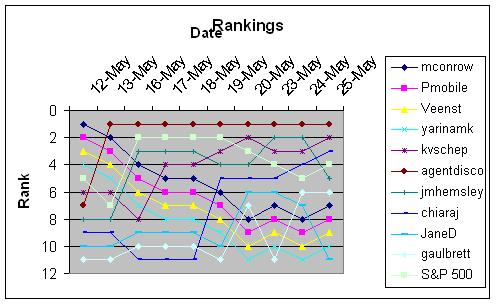
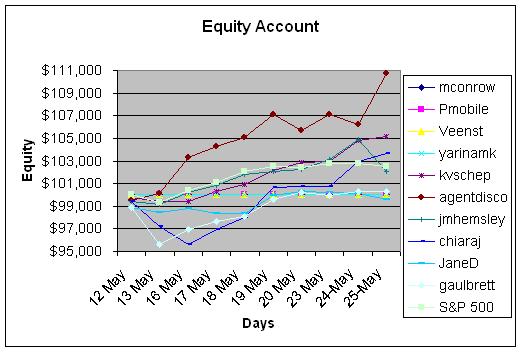
It looks like the wide losses people were experiencing at the beginning of last week are beginning to narrow significantly. Tomorrow, I'll post some more graphs.
My strategy has changed significantly. I've sold most of the stocks that were not performing well and have begun to buy stocks that really show signs of moving. So far, it hasn't worked out great, but we'll see how this ends up on May 31st!
I'd love to hear how others are doing. Leave a comment!
My strategy has changed significantly. I've sold most of the stocks that were not performing well and have begun to buy stocks that really show signs of moving. So far, it hasn't worked out great, but we'll see how this ends up on May 31st!
I'd love to hear how others are doing. Leave a comment!
Wednesday, May 18, 2005
A Vacationer's Tale
I'm heading out of town for a few days on vacation. It's been almost six months since my last vacation which, for me, seems like an extremely long time. I can't wait until "vacation" is what I do most of the time, and I have to work as infrequently as I currently rest. Until then, I will make the most of the next few days.
That means I won't have my eyes and ears glued to the market, although I may check in from time to time. With the unpredictable and volatile nature of the recent market, I don't want to risk coming home to find my portfolio in this game wiped out. I don't even want to drop a couple of percentage points, which can make the difference between top-of-the-pile and bottom-of-the-pile in this game. On the other hand, since 3 out of 4 stocks follow the general direction of the market, if yesterday's rally is the start of something - I don't want to miss out on some gains.
So, my "vacationer's strategy": put in sell stop orders for 1% below yesterday's closing price. If one of my holdings drops 1% from Tuesday's closing price, it sells automatically, thus limiting my downside exposure. But, if stocks rally, I get to take advantage of the upside gains. Not a perfect strategy (a stock could drop 1% in the morning and, after I automatically sell it, it gains 2-3% in the afternoon) - but better than crossing my fingers.
See ya Monday.
That means I won't have my eyes and ears glued to the market, although I may check in from time to time. With the unpredictable and volatile nature of the recent market, I don't want to risk coming home to find my portfolio in this game wiped out. I don't even want to drop a couple of percentage points, which can make the difference between top-of-the-pile and bottom-of-the-pile in this game. On the other hand, since 3 out of 4 stocks follow the general direction of the market, if yesterday's rally is the start of something - I don't want to miss out on some gains.
So, my "vacationer's strategy": put in sell stop orders for 1% below yesterday's closing price. If one of my holdings drops 1% from Tuesday's closing price, it sells automatically, thus limiting my downside exposure. But, if stocks rally, I get to take advantage of the upside gains. Not a perfect strategy (a stock could drop 1% in the morning and, after I automatically sell it, it gains 2-3% in the afternoon) - but better than crossing my fingers.
See ya Monday.
Tuesday, May 17, 2005


The Albatross Around My Neck is Gone and Now It's Working for Me
Yesterday I sold Ford. It is now somebody else's problem. I first sold 750 shares at a 3.20% loss and then another 250 at a 3.75% loss. I took advantage of its higher price yesterday and unloaded.
But then an idea struck me. Why can't I make Ford's poor performance work for me? The stock market has many options for trading, not just buying and selling. What I decided to do was "Short Sell" Ford. What this means is I borrowed money from the broker by "selling" Ford at yesterday's price. Ideally, for this strategy to work, Ford would drop in price (and if you've been reading my other posts, you know it has been), and then I would "buy" or cover the loan by buying the stock back at a lower price. Currently, using this strategy, I'm making a 1.69% profit. As long as Ford keeps dropping, I'll continue to make money, until I decide to repay the loan.
In the meantime, with the money I was loaned by shorting Ford, I bought Adobe Systems, Inc. and Target. As of today, both are doing well.
In other news, the Electronic Entertainment Expo begins today. If you own gaming, entertainment, or electronic hardware stocks, the odds are your stocks are going to rise today. Sony announced their new PS3 system and Microsoft has announced the next generation of the Xbox. Any company that does business with these two, will likely see a jump in their expected returns and hence their stock price.
I'd love to hear from others in the stock market contest. Instructions for initiating a post can be found here.
Later today, I'll post the standings of the Cashtalk stockmarket contest. Keep checking back!
But then an idea struck me. Why can't I make Ford's poor performance work for me? The stock market has many options for trading, not just buying and selling. What I decided to do was "Short Sell" Ford. What this means is I borrowed money from the broker by "selling" Ford at yesterday's price. Ideally, for this strategy to work, Ford would drop in price (and if you've been reading my other posts, you know it has been), and then I would "buy" or cover the loan by buying the stock back at a lower price. Currently, using this strategy, I'm making a 1.69% profit. As long as Ford keeps dropping, I'll continue to make money, until I decide to repay the loan.
In the meantime, with the money I was loaned by shorting Ford, I bought Adobe Systems, Inc. and Target. As of today, both are doing well.
In other news, the Electronic Entertainment Expo begins today. If you own gaming, entertainment, or electronic hardware stocks, the odds are your stocks are going to rise today. Sony announced their new PS3 system and Microsoft has announced the next generation of the Xbox. Any company that does business with these two, will likely see a jump in their expected returns and hence their stock price.
I'd love to hear from others in the stock market contest. Instructions for initiating a post can be found here.
Later today, I'll post the standings of the Cashtalk stockmarket contest. Keep checking back!
Monday, May 16, 2005
PART II - The Future Value (FV) of money and Discounted Cash Flows
Last week, we talked about the Present Value of money and worked a very simple problem to determine how much a single cash flow from the future would be worth today. If you missed that simple review, you can find it here.
Today we are going to learn how to calculate the value of money you have today and find out how much it would be worth in the future if you saved it or invested it. This value is called the Future Value (FV) of money.
This is actually a very simple equation. You take the money you have today (PV or C0) and multiply it by the interest rate ( r ) and add 1:
FV = PV * ( 1 + r )
This equation gives you the Future Value of an amount of money for some period of time. Let’s plug in some numbers and see what we get. Let’s say we have $1,000 and would like to put it in a bank that offers an annual 3.25% interest rate. How much will it be worth in a year?
FV = $1,000 * ( 1 + .0325) = $1,032.50
If you saved $1,000 in a bank, in a year it would be worth $1,032.50. This is fairly simple. Where this simple equation, in addition to the PV equation, becomes quite useful is when you are trying to determine the values of a number of different cash flows.
This leads us to a discussion on finding the Present Value (PV) and Future Values (FV) of multiple cash flows. Let’s return to the PV equation:
PV = C1 / (1 + r )
This equation tells us how much a cash flow one period from now (from now on we’ll assume a period = a year for simplicity sake, but really C1 stands for a cash flow in period 1) will be worth today. Suppose we want to know the value of a cash flow 2 years from now? We would have to discount the interest rate ( r ) by the additional year. So you would get this equation, where C2 is the Year 2 cash flow and the exponent “2” represents the annual interest rate invested over two years:
PV = C2 / (1 + r )^2
Let’s use some real numbers to see how this plays out. If I were to receive $22,000 two years from now, and I could invest that amount in a mutual fund today that has traditionally earned 10% (the opportunity cost of not having the money today), what is that $22,000 worth today?
PV = $22,000 / (1.1)2 = $18,181.82
Now let’s figure out how much a string of cash flows would be worth. Let’s say someone is giving you a business that for 4 years will pay you $3,000 in profits (if only we were all so lucky) every year. How could you find out how much that is worth? Well you can figure out how much each of the cash flows would be worth in its specific year and then add them together. We’ll assume that we could put the money in the bank today and get 3.25% interest. The equation for this example would look like this:
PV = [$3,000 / (1.0325)] + [$3,000 / (1.0325)^2] + [$3,000 / (1.0325)^3] + [$3,000 / (1.0325)^4] = $11,084.95
The value of the business today is $11,084.95. Pretty simple right? Well, there is actually a short cut equation that you can use to find the PV of a string of cash flows which are the same. The equation looks like this:
PV = (C / r ) * [ 1 – 1 / (1 + r)^n]
Or for FV it looks like this:
FV = (C / r ) * [{(1 + r)^n} – 1]
These are called annuities. By using algebra, you can solve for parts of the equations to answer questions about money. Let’s use them to figure out how much money I need to save to retire. If I wanted to have a million dollars when I retire (in 30 years) and I knew I could get 10% in a mutual fund starting today, how much money should I contribute a year?
FV = $1,000,000
r = 10%
n = 30
$1,000,000 = (C / 0.1)*[{(1.1)^30} – 1] =
I would have to contribute $6,079.25 a year to have $1,000,000 in 30 years at 10% interest.
Plug your own numbers in. Need to know how much interest you’re paying on your car loan? Plug it in:
You make $375 monthly payments (C) on a $15,000 (PV) car for the next 4 years (n/12). Just solve for r:
$15,000 = ($375/r)*[1 – 1/(1+r)^48]
In this particular problem, you’re monthly interest rate would be 0.77015%. This would compound to an APR of about 9.242%. There you have it. This is the power of the time value of money. If you have any questions, please leave a comment. There will more to come!
Today we are going to learn how to calculate the value of money you have today and find out how much it would be worth in the future if you saved it or invested it. This value is called the Future Value (FV) of money.
This is actually a very simple equation. You take the money you have today (PV or C0) and multiply it by the interest rate ( r ) and add 1:
FV = PV * ( 1 + r )
This equation gives you the Future Value of an amount of money for some period of time. Let’s plug in some numbers and see what we get. Let’s say we have $1,000 and would like to put it in a bank that offers an annual 3.25% interest rate. How much will it be worth in a year?
FV = $1,000 * ( 1 + .0325) = $1,032.50
If you saved $1,000 in a bank, in a year it would be worth $1,032.50. This is fairly simple. Where this simple equation, in addition to the PV equation, becomes quite useful is when you are trying to determine the values of a number of different cash flows.
This leads us to a discussion on finding the Present Value (PV) and Future Values (FV) of multiple cash flows. Let’s return to the PV equation:
PV = C1 / (1 + r )
This equation tells us how much a cash flow one period from now (from now on we’ll assume a period = a year for simplicity sake, but really C1 stands for a cash flow in period 1) will be worth today. Suppose we want to know the value of a cash flow 2 years from now? We would have to discount the interest rate ( r ) by the additional year. So you would get this equation, where C2 is the Year 2 cash flow and the exponent “2” represents the annual interest rate invested over two years:
PV = C2 / (1 + r )^2
Let’s use some real numbers to see how this plays out. If I were to receive $22,000 two years from now, and I could invest that amount in a mutual fund today that has traditionally earned 10% (the opportunity cost of not having the money today), what is that $22,000 worth today?
PV = $22,000 / (1.1)2 = $18,181.82
Now let’s figure out how much a string of cash flows would be worth. Let’s say someone is giving you a business that for 4 years will pay you $3,000 in profits (if only we were all so lucky) every year. How could you find out how much that is worth? Well you can figure out how much each of the cash flows would be worth in its specific year and then add them together. We’ll assume that we could put the money in the bank today and get 3.25% interest. The equation for this example would look like this:
PV = [$3,000 / (1.0325)] + [$3,000 / (1.0325)^2] + [$3,000 / (1.0325)^3] + [$3,000 / (1.0325)^4] = $11,084.95
The value of the business today is $11,084.95. Pretty simple right? Well, there is actually a short cut equation that you can use to find the PV of a string of cash flows which are the same. The equation looks like this:
PV = (C / r ) * [ 1 – 1 / (1 + r)^n]
Or for FV it looks like this:
FV = (C / r ) * [{(1 + r)^n} – 1]
These are called annuities. By using algebra, you can solve for parts of the equations to answer questions about money. Let’s use them to figure out how much money I need to save to retire. If I wanted to have a million dollars when I retire (in 30 years) and I knew I could get 10% in a mutual fund starting today, how much money should I contribute a year?
FV = $1,000,000
r = 10%
n = 30
$1,000,000 = (C / 0.1)*[{(1.1)^30} – 1] =
I would have to contribute $6,079.25 a year to have $1,000,000 in 30 years at 10% interest.
Plug your own numbers in. Need to know how much interest you’re paying on your car loan? Plug it in:
You make $375 monthly payments (C) on a $15,000 (PV) car for the next 4 years (n/12). Just solve for r:
$15,000 = ($375/r)*[1 – 1/(1+r)^48]
In this particular problem, you’re monthly interest rate would be 0.77015%. This would compound to an APR of about 9.242%. There you have it. This is the power of the time value of money. If you have any questions, please leave a comment. There will more to come!
C'mon, Big Money
Thought I would post a bit about my current strategy for our 3-week game.
First of all, let me say that I would not pursue this line of thinking in "real life" because A) small percentage point gains get eaten up quickly by commissions with a few thousand bucks invested, as opposed to the hundred thousand I have in this game, and B) it's pretty stupid.
But it appears to be working - today, at least. I want to be in no more than 4-7 stocks at a time. I made my initial purchases based on recently strong relative price performance and leadership within their respective industries.
Whole Foods was dragging me down for a few days, so I sold it at a 3% loss and split the money between Orthofix Intl. (OFIX) and Pantry Inc. (PTRY). So far today, OFIX is dragging and PTRY is cooking. I also used margin to buy American Healthways (AMHC) and Par Technologies (PTC). Both are up.
So why did I do what I did, and why is it stupid? I'm basically chasing volume. Stocks that are moving up on high volume? I buy 'em. If they produce 2-5% gains within a day, I'm happy. If not, I dump 'em and move on to other stocks trading higher on higher-than-average volume. The logic is basic supply-and-demand. Higher-than-average volume (and I mean significantly higher volume - several hundred %) implies that a large number of buyers (probably institutional) are chasing after a relatively few number of shares. This drives the price up. If I can get in on this before all these large buyers-and-sellers are satisfied, there's likely some cash in it for me.
But again, 2-5% on $100K is worth the $19.95 commission. Making $20 to $50 on a $1000, and having a big chunk of that eaten up in commissions? Why bother. Also, note I am blatantly chasing these returns. The cat is already well out of the bag by the time I buy, so I am missing out on the biggest gains - and setting myself up for a scenario where there's an early morning runup, then I buy, then people start selling and I lose my dough. Not a plan for long-term success.
But for 3 weeks? We'll see. NVDA and OFIX better shape up, or on the chopping block they go by the end of the day.
First of all, let me say that I would not pursue this line of thinking in "real life" because A) small percentage point gains get eaten up quickly by commissions with a few thousand bucks invested, as opposed to the hundred thousand I have in this game, and B) it's pretty stupid.
But it appears to be working - today, at least. I want to be in no more than 4-7 stocks at a time. I made my initial purchases based on recently strong relative price performance and leadership within their respective industries.
Whole Foods was dragging me down for a few days, so I sold it at a 3% loss and split the money between Orthofix Intl. (OFIX) and Pantry Inc. (PTRY). So far today, OFIX is dragging and PTRY is cooking. I also used margin to buy American Healthways (AMHC) and Par Technologies (PTC). Both are up.
So why did I do what I did, and why is it stupid? I'm basically chasing volume. Stocks that are moving up on high volume? I buy 'em. If they produce 2-5% gains within a day, I'm happy. If not, I dump 'em and move on to other stocks trading higher on higher-than-average volume. The logic is basic supply-and-demand. Higher-than-average volume (and I mean significantly higher volume - several hundred %) implies that a large number of buyers (probably institutional) are chasing after a relatively few number of shares. This drives the price up. If I can get in on this before all these large buyers-and-sellers are satisfied, there's likely some cash in it for me.
But again, 2-5% on $100K is worth the $19.95 commission. Making $20 to $50 on a $1000, and having a big chunk of that eaten up in commissions? Why bother. Also, note I am blatantly chasing these returns. The cat is already well out of the bag by the time I buy, so I am missing out on the biggest gains - and setting myself up for a scenario where there's an early morning runup, then I buy, then people start selling and I lose my dough. Not a plan for long-term success.
But for 3 weeks? We'll see. NVDA and OFIX better shape up, or on the chopping block they go by the end of the day.
Friday, May 13, 2005
James' Portolio Update
Today is a strange day in the market. The markets started down today, but are recovering. But, if you look at the rankings of the stockmarket simulation, you'll notice that those participants who haven't bought any stocks are doing better than those who did!
I thought I'd let you know what's happening with my portfolio. Yesterday, Altair Nanotechnologies in Reno, NV, released their quarterly earnings report. They had significantly higher earnings than they had predicted. Before yesterday the stock was hovering around $3.08 a share. I had bought it originally at $3.13. The report caused the stock to shoot up to $3.70. For some reason I sensed that this must be an anomaly and after a few hours of mulling it over, I put a stop-loss sell order for ALTI at $3.20 - meaning if the stock dropped down to $3.20, the "broker" would automatically sell it. Well, this morning, it opened at $3.24 and kept sinking. Fortunately, I'm out at $3.20 (a small gain). Right now, the stock is trading at $3.08 again. This article from the Motley Fool shed some light on these fluctuations.
I'm taking the money I made on ALTI and putting it into Amgen. Their stock has been the only one in my portfolio that has maintained a positive upward trend. I've put a buy-limit of $61.90 on the stock - meaning the "broker" will buy it when it reaches that price. It's currently trading at $62.02.
Not everything is coming up roses. Ford is destroying most of my portfolio. I bought it at $9.95 and it is currently trading at $9.33. That's over a 6% loss! I've put a stop-loss sell order on ford of $9.17. When it reaches that level, I'll take the loss of 8% and buy something else. I'm hoping it doesn't get to that.
I'd love to hear other people's ideas on this simulation. Make a quick post and let us all know how you are doing. Or post a comment here and let me know what the next great stock is!
I thought I'd let you know what's happening with my portfolio. Yesterday, Altair Nanotechnologies in Reno, NV, released their quarterly earnings report. They had significantly higher earnings than they had predicted. Before yesterday the stock was hovering around $3.08 a share. I had bought it originally at $3.13. The report caused the stock to shoot up to $3.70. For some reason I sensed that this must be an anomaly and after a few hours of mulling it over, I put a stop-loss sell order for ALTI at $3.20 - meaning if the stock dropped down to $3.20, the "broker" would automatically sell it. Well, this morning, it opened at $3.24 and kept sinking. Fortunately, I'm out at $3.20 (a small gain). Right now, the stock is trading at $3.08 again. This article from the Motley Fool shed some light on these fluctuations.
I'm taking the money I made on ALTI and putting it into Amgen. Their stock has been the only one in my portfolio that has maintained a positive upward trend. I've put a buy-limit of $61.90 on the stock - meaning the "broker" will buy it when it reaches that price. It's currently trading at $62.02.
Not everything is coming up roses. Ford is destroying most of my portfolio. I bought it at $9.95 and it is currently trading at $9.33. That's over a 6% loss! I've put a stop-loss sell order on ford of $9.17. When it reaches that level, I'll take the loss of 8% and buy something else. I'm hoping it doesn't get to that.
I'd love to hear other people's ideas on this simulation. Make a quick post and let us all know how you are doing. Or post a comment here and let me know what the next great stock is!
Thursday, May 12, 2005
Is your job your calling?
Every year about this time, articles are written about how college kids are going out into the world to find a job. This article caught my eye because it deals specifically with M.B.A.s. There's really nothing new here. M.B.A.s are going for the highest pay. You couldn't get any more obvious than that, could you?
That's why I like this piece by Marvin Olasky about doing something you're called to do. Something that will use your gifts and that will satisfy you. Not just doing something because it gives you the most money or prestige.
Check it out and let me know what you think.
That's why I like this piece by Marvin Olasky about doing something you're called to do. Something that will use your gifts and that will satisfy you. Not just doing something because it gives you the most money or prestige.
Check it out and let me know what you think.
The Time Value of Money: Part I - The Present Value (PV) of money
This is the first of a multi-part series exploring the time value of money. I will attempt to answer how much a dollar is worth today and tomorrow based on the opportunity cost available to you. This is called the Time Value of Money (TVM). The power behind the equations you’ll learn (if you haven’t already) is the basis for much of modern finance theory and the decisions based on that theory. Getting a firm grasp on this subject will allow you to make sound financial decisions, not just in the stock market, but in your daily life.
First, we’ll go over some basics. On April 16th, I posted the “5 forces of Finance.” These primary ideas are what form the background behind TVM and more specifically the Present Value (PV) of Money, especially point 2.
The Present Value of Money is actually fairly intuitive. If you have $100,000 today, how much is it worth? Obviously the answer is $100,000. But if you were to receive $100,000 a year from now, how much would it be worth? The answer to that is based on what you could do with the same money if you had it today. This “Discount Factor” is the same as the opportunity cost. If we had that $100,000 today, we could invest it at a certain rate. If I put it in the bank, and earned 3% annual interest, at the end of a year, I would have $103,000. This is actually called the Future Value (FV) of Money.
Because of the opportunity cost or the income I would lose, $100,000 a year from now is not worth $100,000 today. To figure out how much it would be worth, you use the Discount Factor or Discount Rate ( r ) in the following equation where r is the opportunity to make money on another investment and C1 is the expected cash flow in the first period:
PV = ( 1 / 1 + r ) x C1 or PV = C1 / 1 + r
If we solve the above problem with this equation, assuming that we could get 3% annually, it looks like this:
PV = ( 1 / 1 + .03 ) x $100,000 = $97,087.38
$100,000 a year from now is actually worth $97,087.38 today. Why is this valuable? Let’s apply it to a realistic problem. Let’s say you have a business project that you know will result in $60,000 income in 6 months. Right now, investors could get an annual return of 3.19% by buying a no-risk, 6-month treasury bill (we’ll talk about risk another time). If you wanted to sell that project today, how much would you ask for it or what is the fair value (a.k.a. PV)? Let’s plug it into the equation:
PV = $60,000 / 1 + [half the annual return is 0.01595] = $59,058.24
So there you have it. A fair price for the project would be $59,058.24.
Now you can tell how much something is worth today based on the opportunity cost of investing the money elsewhere. In the next part we’ll explore some more practical applications of PV and cover Net Present Value. If you have any questions, please post a comment and I'll try and answer it quickly. Keep checking back!
First, we’ll go over some basics. On April 16th, I posted the “5 forces of Finance.” These primary ideas are what form the background behind TVM and more specifically the Present Value (PV) of Money, especially point 2.
The Present Value of Money is actually fairly intuitive. If you have $100,000 today, how much is it worth? Obviously the answer is $100,000. But if you were to receive $100,000 a year from now, how much would it be worth? The answer to that is based on what you could do with the same money if you had it today. This “Discount Factor” is the same as the opportunity cost. If we had that $100,000 today, we could invest it at a certain rate. If I put it in the bank, and earned 3% annual interest, at the end of a year, I would have $103,000. This is actually called the Future Value (FV) of Money.
Because of the opportunity cost or the income I would lose, $100,000 a year from now is not worth $100,000 today. To figure out how much it would be worth, you use the Discount Factor or Discount Rate ( r ) in the following equation where r is the opportunity to make money on another investment and C1 is the expected cash flow in the first period:
PV = ( 1 / 1 + r ) x C1 or PV = C1 / 1 + r
If we solve the above problem with this equation, assuming that we could get 3% annually, it looks like this:
PV = ( 1 / 1 + .03 ) x $100,000 = $97,087.38
$100,000 a year from now is actually worth $97,087.38 today. Why is this valuable? Let’s apply it to a realistic problem. Let’s say you have a business project that you know will result in $60,000 income in 6 months. Right now, investors could get an annual return of 3.19% by buying a no-risk, 6-month treasury bill (we’ll talk about risk another time). If you wanted to sell that project today, how much would you ask for it or what is the fair value (a.k.a. PV)? Let’s plug it into the equation:
PV = $60,000 / 1 + [half the annual return is 0.01595] = $59,058.24
So there you have it. A fair price for the project would be $59,058.24.
Now you can tell how much something is worth today based on the opportunity cost of investing the money elsewhere. In the next part we’ll explore some more practical applications of PV and cover Net Present Value. If you have any questions, please post a comment and I'll try and answer it quickly. Keep checking back!
People should be paid what their work is worth
There are some sound economic principles in this op-ed piece by Thomas Sowell. He talks about a recent New York Times article that reviews an upcoming book that calls for Wal-Mart to pay more to its employees. Not for any other reason than that they are "obliged."
He raises these interesting questions:
He raises these interesting questions:
Should people be paid according to what they "need" instead of according to what their work is worth?
If their (the employees) work is not worth enough to pay for what they want, is it up to others to make up the difference, rather than up to them to upgrade their skills in order to earn what they want?I tend to agree with his perspective in the article. Wal-Mart seems to be a whipping boy for anyone that wants to take shots at a large coporation. I think most of these types of attacks come as the result of a general distrust of all corporations and without the consideration of the benefits that comapanies like Wal-Mart provide. I'd love to hear your own opinions so leave a comment.
Are they supposed to be subsidized by Wal-Mart's (or any other company's) customers through higher prices or subsidized by Wal-Mart's stockholders through lower earnings?
Tuesday, May 10, 2005
Ford and GM's Bonds downgraded to "Junk"
This actually happened a few days ago, but looking at my portolio in the contest, it explains quite a bit. I've lost 2.21% on Ford since yesterday. That could easily change and move back up, but according to this article from the Economist, that may not be likely.
From the looks of it, I probably should have bought GM. At least they have a major institutional investor backing them up and have recently brought on new management. The article does not mention anything Ford has done to turn the tide of pessism regarding American motor companies.
From the looks of it, I probably should have bought GM. At least they have a major institutional investor backing them up and have recently brought on new management. The article does not mention anything Ford has done to turn the tide of pessism regarding American motor companies.
Monday, May 09, 2005
Why I chose the stocks I did
I have entered this contest from the perspective that no matter how hard you try, you cannot do better than the market in general. This stance is based on the Efficient Market Theory. This essentially means that the stock price already incorporates all known information about the company. There are no surprises.
Obviously, this is just a theory, but what better way to test it than through a game?
My strategy for picking stocks is based solely on places I have happened to live and companies I either happen to recognize based on my living there, or have found by searching Google and Yahoo.
I tried to diversify where possible. My portfolio contains stocks in entertainment to Biotech. I tried to spend about $7,000 to $11,000 on each stock. I have a total of 13 companies. Becasue of the effects of Covariance, I believe that my portfolio should do pretty much what the S&P500 is doing.
Below is a list of the companies in my portfolio. I only have a little money left, so I don't think I'll be adding any to this list.
Los Angeles (Birthplace)
Northrop Grunman - Aerospace
Time Warner - Entertainment (They're actually based in New York, but I was thinking Warner Bros. Pictures when I bought)
Disney - Entertainment
Philedelphia
Wyeth - Health Care (They're actually in NJ, but I thought that was close enough.)
Mt. Clemens/Dearborn/Detroit
Ford Motor Co. - Automobiles (We'll see how this bear effects the portfolio.)
Bremerton/Seattle
Microsoft - Computer Software/Services
Amazon.com - Internet Commerce
Ventura, CA
Amgen - Health Care
Grand Rapids, MI
Herman Miller - Furniture
I'm skipping China, as there aren't too many Chinese companies traded in North America
Iowa City, IA
Rockwell Collins - Aerospace
Reno (I never lived here, but my parents do!)
Altair Nanotechnologies - Chemical Engineering
I also chose two other companies: Electronic Arts and Google. EA because I wouldn't mind working for them in the future and Google because Cashtalk is hosted by Blogger.com, which is owned by Google!
There you have it. Those are my picks. Fairly diversified for having only 13 stocks. As of this posting, I'm already up 0.23%. We'll see what happens in the next few weeks.
If you have any questions, or would like to tell me what you bought and why, please post a comment!
Obviously, this is just a theory, but what better way to test it than through a game?
My strategy for picking stocks is based solely on places I have happened to live and companies I either happen to recognize based on my living there, or have found by searching Google and Yahoo.
I tried to diversify where possible. My portfolio contains stocks in entertainment to Biotech. I tried to spend about $7,000 to $11,000 on each stock. I have a total of 13 companies. Becasue of the effects of Covariance, I believe that my portfolio should do pretty much what the S&P500 is doing.
Below is a list of the companies in my portfolio. I only have a little money left, so I don't think I'll be adding any to this list.
Los Angeles (Birthplace)
Northrop Grunman - Aerospace
Time Warner - Entertainment (They're actually based in New York, but I was thinking Warner Bros. Pictures when I bought)
Disney - Entertainment
Philedelphia
Wyeth - Health Care (They're actually in NJ, but I thought that was close enough.)
Mt. Clemens/Dearborn/Detroit
Ford Motor Co. - Automobiles (We'll see how this bear effects the portfolio.)
Bremerton/Seattle
Microsoft - Computer Software/Services
Amazon.com - Internet Commerce
Ventura, CA
Amgen - Health Care
Grand Rapids, MI
Herman Miller - Furniture
I'm skipping China, as there aren't too many Chinese companies traded in North America
Iowa City, IA
Rockwell Collins - Aerospace
Reno (I never lived here, but my parents do!)
Altair Nanotechnologies - Chemical Engineering
I also chose two other companies: Electronic Arts and Google. EA because I wouldn't mind working for them in the future and Google because Cashtalk is hosted by Blogger.com, which is owned by Google!
There you have it. Those are my picks. Fairly diversified for having only 13 stocks. As of this posting, I'm already up 0.23%. We'll see what happens in the next few weeks.
If you have any questions, or would like to tell me what you bought and why, please post a comment!
The Contest Has Begun!
Today is May 9th, 2005 and the Cashtalk stock portfolio contest has started. If you want to view the standings, you can click here. I will try and post a weekly summary of the standings and call attention to any highlights.
If you haven't joined yet, you can still get on board and learn about the stock market by clicking here. The more the merrier!
Good luck everyone!
If you haven't joined yet, you can still get on board and learn about the stock market by clicking here. The more the merrier!
Good luck everyone!
Thursday, May 05, 2005
Stocks & Social Security Will BOTH Fail - Nothing Can Save You Now!
Get ready for a retirement spent working the drive-thru window - at least if you believe this article in today's Journal by famed economist and author Jeremy Siegel.
Although Siegel's views are disputed by other knowledgable folks, I have to admit I had never considered what he is suggesting will happen to the stock markets once baby boomers start selling their stock for income. Whether you agree or not, it's a point of view you don't hear about too often - yet.
Posted in the comments.
Although Siegel's views are disputed by other knowledgable folks, I have to admit I had never considered what he is suggesting will happen to the stock markets once baby boomers start selling their stock for income. Whether you agree or not, it's a point of view you don't hear about too often - yet.
Posted in the comments.
Wednesday, May 04, 2005
Cashtalk Stock Market Contest!
Agent Disco and I have decided to have a stock trading contest. The contest starts on May 9th and ends on May 31st.
We would like all of our readers and members to parcticipate and Investopedia.com makes it quite easy to do so.
The way the "Game" works is you start with $100k and are able to buy and sell, stocks, options and bonds that are listed in any North American exchange. I will be able to keep track of how people are doing and will occasionally post results here at Cashtalk.
Trades work as if you traded through a company like Scottrade or Ameritrade. You pay a commission for each purchase or sale. It will be up to you to decide when and what to buy or sell.
The person with the highest portfolio value wins the recognition of his or her peers and will be lauded on this blog until we run out of breath or find something else to do.
We would love for you to play, not just so you can achieve fame and recognition by your peers, but so you can take this opportunity to learn more about stocks and the market.
Personally, my strategy will be to buy one or two stocks from each of the places I've lived in my life. I'll have more info about those stocks on Monday. I'll probably hold on to them after the initial purchase. You can do whatever you want. Choose your own style and learn from the experience.
If you don't know much about stocks, want to do research, or want to know the ticker symbol of a company, I recommend these two sites:
MSN Money Central
and
Yahoo! Finance
Each of these sites have excellent "look-up" tools and a lot of statistics (if you're the type of person that finds that interesting and useful).
Ideally, over the next 3 weeks, we can discuss our picks and talk about why we made the decisions we did. This can be a great learning experience for everyone involved.
We'd love for you to play. To join, you just need to click "here"
We would like all of our readers and members to parcticipate and Investopedia.com makes it quite easy to do so.
The way the "Game" works is you start with $100k and are able to buy and sell, stocks, options and bonds that are listed in any North American exchange. I will be able to keep track of how people are doing and will occasionally post results here at Cashtalk.
Trades work as if you traded through a company like Scottrade or Ameritrade. You pay a commission for each purchase or sale. It will be up to you to decide when and what to buy or sell.
The person with the highest portfolio value wins the recognition of his or her peers and will be lauded on this blog until we run out of breath or find something else to do.
We would love for you to play, not just so you can achieve fame and recognition by your peers, but so you can take this opportunity to learn more about stocks and the market.
Personally, my strategy will be to buy one or two stocks from each of the places I've lived in my life. I'll have more info about those stocks on Monday. I'll probably hold on to them after the initial purchase. You can do whatever you want. Choose your own style and learn from the experience.
If you don't know much about stocks, want to do research, or want to know the ticker symbol of a company, I recommend these two sites:
MSN Money Central
and
Yahoo! Finance
Each of these sites have excellent "look-up" tools and a lot of statistics (if you're the type of person that finds that interesting and useful).
Ideally, over the next 3 weeks, we can discuss our picks and talk about why we made the decisions we did. This can be a great learning experience for everyone involved.
We'd love for you to play. To join, you just need to click "here"
Only in America: Hard work can pay off
I have to admit, I really like reading Walter Williams. He is a very practical economist who teaches at George Mason University. Today he wrote an article about the dynamics of the rich in America. Most people who are rich have become rich through their hard work and good ideas.
People in America who start out poor statistically move up the tax brackets until they land on the highest. He also cites "The Millionaire Next Door" by Thomas Stanley. I'm going to have to pick this book up, as it has been mentioned by a number of people I respect as a good book analyzing the practices of the rich in America.
People in America who start out poor statistically move up the tax brackets until they land on the highest. He also cites "The Millionaire Next Door" by Thomas Stanley. I'm going to have to pick this book up, as it has been mentioned by a number of people I respect as a good book analyzing the practices of the rich in America.
Tuesday, May 03, 2005
The American Economy: Two Perspectives
I saw these two articles and, at first, thought that they were totally different in their perspectives on the American economy. One of them is decidedly optimitistic and the other is more pessimistic.
But when I began to read each of them, they essentially say the same thing: that, based on recent economic indicators, Americans are doing fairly well. At least we are no where near "Stagflation," or recession.
Have a read and then leave a note.
Stagflation Nonsense by Larry Kudrow
The Global Locomotive Loses Steam (The Economist)
But when I began to read each of them, they essentially say the same thing: that, based on recent economic indicators, Americans are doing fairly well. At least we are no where near "Stagflation," or recession.
Have a read and then leave a note.
Stagflation Nonsense by Larry Kudrow
The Global Locomotive Loses Steam (The Economist)
The skinny on CAN SLIM
So I've been doing a bit of reading lately of books by William O'Neil, the founder of Investors Business Daily newspaper. He claims his method of picking winning stocks - CAN SLIM - if followed consistently and absolutely to the letter of the law, will yield substantial gains more often than not. Now, the other side of the room says that this (or any) kind of technical analysis is a joke - that the market cannot, on average, be beaten.
Here's some info on CAN SLIM from Investopedia. Take a look for yourself, let me know what you think. If any of you have used this or another strategy, post your thoughts.
Here's some info on CAN SLIM from Investopedia. Take a look for yourself, let me know what you think. If any of you have used this or another strategy, post your thoughts.
Steve "Lenin" Jobs
Here are some pointed remarks in today's Journal about Steve Jobs' personality traits. The article raises the question of what would have happened to Mr. Jobs had he been born in Russia or China.
Posted in the comments for those without subscriptions, although you really should subscribe.
Posted in the comments for those without subscriptions, although you really should subscribe.
Monday, May 02, 2005
Portfolio Survey
Just thought it might be interesting to post what major fund managers are holding in their portfolios.
Portfolio Poll
Portfolio Poll
Nervous Stockmarket = Nervous CEOs
An Economist article here talks about the recent ups and downs of the S&P500. An interesting point it makes is that companies (at least large ones) are not reinvesting their money into high Net Present Value projects. In order to sustain growth, a company must continue to reinvest their revenues into projects that provide a significant return. The article points out that companies are keeping large stocks of cash or paying it out to investors rather than looking for a great product or service that might increase its longterm revenues. This has the effect of causing companies to rise and fall with the large-scale economy rather than let them be the masters of their own destinies. Unfortunately, this also stifles innovation.
Subscribe to:
Posts (Atom)