Friday, July 15, 2005
GM's Marketing Ploy a Success!
Ah...summer. Hot, humid days, outdoor cookouts, swimming pools and...new cars? If you've been watching TV lately, you may have noticed car commercials that offer a great rate on their models: you get the same discount that the employees do. Its a creative tactic and apparently its working. GM has increased their sales 41% last month. Chrysler and Ford have followed suit (even after Ford initially declined to copycat. I guess the numbers that GM put up convinced Ford to change its strategy) . Apparently feeling like an employee of a major car company is what the American public wanted? These are some serious discounts: A Ford Explorer normally goes for $32,895 but with the dicount it costs $28,739 (still too rich for my blood). Read the articles here and here.


Wednesday, July 06, 2005
Google: What an amazing company!
"If only I'd bought," you might think to yourself. Well, that's what I'm thinking. Google just keeps going up and this article from the Economist might have an explanation as to why this company's stock keeps rocketing higher. Right now, Google is worth over $80 billion dollars. More than Yahoo!, Ebay, Amazon, or even "brick and mortar" companies like Time Warner. And as long as the price keeps going up, and as the article alludes to, more and more innovations are made public, Google will be valued higher and higher.
Summer Sunshine: What the FDA doesn't want you to know
John Stossel wrote a great article here about Mexoryl, a sunblock ingredient that helps block UVA rays. Most of the world uses this ingredient, coupled with others to effectively block out all harmful effects of sunlight. But the FDA has refused to approve it. It has even refused to explain why it isn't approving it for public use. So Americans can just get more wrinkly, I guess.
Friday, July 01, 2005
Everything an MBA should know
QuickMBA is a great site that allows anyone to see the typical topics and subjects that are covered in major MBA programs across the country. What it does is break the classes out into what is expected of the students to know after they have paid thousands of dollars for the class and taken the tests. If you don't want to make that kind of comittment, I suggest you check it out and even bookmark the site.
A friend of mine from my most recent MBA class directed me to this site when we realized the teacher wasn't actually going to teach us anything. I used the site to peruse the subject matter and it helped with getting a grasp on the material, as well as figure out what we should have been learning.
Cashtalk will add the site to the list of links on the right side. Make sure you look at it and if you have any questions about the topics, I've almost got my MBA, so feel free to ask!
A friend of mine from my most recent MBA class directed me to this site when we realized the teacher wasn't actually going to teach us anything. I used the site to peruse the subject matter and it helped with getting a grasp on the material, as well as figure out what we should have been learning.
Cashtalk will add the site to the list of links on the right side. Make sure you look at it and if you have any questions about the topics, I've almost got my MBA, so feel free to ask!
A Comprehensive Survey of the Worldwide Housing Market
The Economist, two weeks ago, published a fairly comprehensive survey of the world housing market. They believe that for the most part the "bubble" has peaked. What I find staggering is the amount of equity they estimate could be affected (in the trillions). They say that this is the largest "bubble" in history and is being caused by low interest rates, distrust of stocks as an investment tool (and therefore people tend to look at houses as an investment rather than a place to live) and the use of second-mortgages or home equity loans to fuel consumer spending.
This is one of the better written historical and predictive surveys I've seen on the topic. If you haven't really understood the implications about all the talk around the housing bubble, this would be a good place to catch up, as well as read about potential future scenarios. Check it out and let us know what you think. (I've posted the article in the comments section).
This is one of the better written historical and predictive surveys I've seen on the topic. If you haven't really understood the implications about all the talk around the housing bubble, this would be a good place to catch up, as well as read about potential future scenarios. Check it out and let us know what you think. (I've posted the article in the comments section).
A Wake Up Call from the Fool
Ah, retirement. For most of us, it seems to be a long way off, for others it is right around the corner. Some of us think about it and plan for it (as we should) and others just hope the dice land with favorable numbers.
The Motley Fool has an article with some pretty surprising numbers about how many people in the US are not planning for retirement, even though they have access to 401(k) plans or IRAs. The article points out that you will need $1 million dollars by the time you are ready to retire, in order to cover your living costs and other expensive needs (medical coverage, anyone?).
I contribute the maximum amount to my 403(b) (I work for a non-profit company) and am preparing to invest additional after-tax money in a Roth IRA. My goal is to have around $1.5 million by the time I retire in order to take care of myself and my family (selfish reasons) and to be less of a burden on society (unselfish reasons). I hope the rest of you are just as "foolish."
The Motley Fool has an article with some pretty surprising numbers about how many people in the US are not planning for retirement, even though they have access to 401(k) plans or IRAs. The article points out that you will need $1 million dollars by the time you are ready to retire, in order to cover your living costs and other expensive needs (medical coverage, anyone?).
I contribute the maximum amount to my 403(b) (I work for a non-profit company) and am preparing to invest additional after-tax money in a Roth IRA. My goal is to have around $1.5 million by the time I retire in order to take care of myself and my family (selfish reasons) and to be less of a burden on society (unselfish reasons). I hope the rest of you are just as "foolish."
Wednesday, June 29, 2005
Ad hoc
I wonder if anyone is still here.
I am emerging from a month of nonstop, mind-numbing class and travel. All I want to do is sleep and realize with glee every half-hour or so that I'm not in class. It feels good.
Jim Cramer's Mad Money has been on TV the last few nights, as it is every night, and I've been home and able to watch it. But right now I could care less. I don't want to watch it. I don't want to hear about stocks. I don't want to hear about the economy. I don't want to hear about oil, or China, or the housing bubble for the umpteenth time.
It's OK, though. I've been in this frame of mind before - enough times now to start to recognize it. Unlike ten years ago when I used a theatre class project to symbolically burn posters and memorabilia from a play I had just produced, so worn out was I with caring about it, there will be no bonfire of textbooks in the backyard's fire pit. I did that once, too - burn a Physics book. Should have saved it, for the third time I took the class some 7 or 8 years later.
No, this time I recognize this for what it is: a break in an intense relationship with something I do care deeply about. A hiatus. A shifting. Not an abandonment. I will have my nose in Bill O'Neil's book again soon enough, and that subscription renewal to the Journal is already sitting sealed in an envelope. But I also recognize that I will not be a stock analyst, or a financial genius, or a lawyer by the time I'm 35. And that's fine. Check a few more things off the damn list.
I still watch Squawk Box in the morning, but am only half-interested in the news. It is more fascinating right now to watch the dynamic between Becky Quick and David Faber. I think that Becky feels like she has something to prove - like she's nervous about being at the table with the big kids. David is smart, charming and at ease, and seemingly always finds an angle to something that puts Becky on the defense. When this happens - which is often - the rest of the table, including the guest host (who is a man 99% of the time) devolves into a rowdy boy's club of sorts. Even when David's not there, Becky speaks so quickly and scripted that she finishes her speech, takes a breath, and the dead air swallows her whole. So I feel sorry for Becky, because she's probably pretty good at what she does and pretty smart. But she comes off as desperate, because the people around are just, well, better.
Maybe I'm sexist. But I don't think so. Maria Bartiromo could kick my ass.
Happy summer, everyone.
I am emerging from a month of nonstop, mind-numbing class and travel. All I want to do is sleep and realize with glee every half-hour or so that I'm not in class. It feels good.
Jim Cramer's Mad Money has been on TV the last few nights, as it is every night, and I've been home and able to watch it. But right now I could care less. I don't want to watch it. I don't want to hear about stocks. I don't want to hear about the economy. I don't want to hear about oil, or China, or the housing bubble for the umpteenth time.
It's OK, though. I've been in this frame of mind before - enough times now to start to recognize it. Unlike ten years ago when I used a theatre class project to symbolically burn posters and memorabilia from a play I had just produced, so worn out was I with caring about it, there will be no bonfire of textbooks in the backyard's fire pit. I did that once, too - burn a Physics book. Should have saved it, for the third time I took the class some 7 or 8 years later.
No, this time I recognize this for what it is: a break in an intense relationship with something I do care deeply about. A hiatus. A shifting. Not an abandonment. I will have my nose in Bill O'Neil's book again soon enough, and that subscription renewal to the Journal is already sitting sealed in an envelope. But I also recognize that I will not be a stock analyst, or a financial genius, or a lawyer by the time I'm 35. And that's fine. Check a few more things off the damn list.
I still watch Squawk Box in the morning, but am only half-interested in the news. It is more fascinating right now to watch the dynamic between Becky Quick and David Faber. I think that Becky feels like she has something to prove - like she's nervous about being at the table with the big kids. David is smart, charming and at ease, and seemingly always finds an angle to something that puts Becky on the defense. When this happens - which is often - the rest of the table, including the guest host (who is a man 99% of the time) devolves into a rowdy boy's club of sorts. Even when David's not there, Becky speaks so quickly and scripted that she finishes her speech, takes a breath, and the dead air swallows her whole. So I feel sorry for Becky, because she's probably pretty good at what she does and pretty smart. But she comes off as desperate, because the people around are just, well, better.
Maybe I'm sexist. But I don't think so. Maria Bartiromo could kick my ass.
Happy summer, everyone.
Friday, June 17, 2005
The FDA Should be Dismantled to Encourage Economic Growth
Well it has been a while since I've had a chance to post. Most of the delay was caused by a class I am taking called Securities Analysis. It has been a good experience, and I have learned a lot about valuing companies and using current events to estimate a company's present value, and hence share price.
I did two projects and presented the results to the class. The first project was about Pfizer. They are a large drug company that manufacture a number of well-known drugs including Viagra. The second project was to summarize and report on the Biotech industry and then value Genentech, a biotech company in San Francisco.
One of the interesting things I came across as I put together these reports was the amount of reliance these companies, in both the Pharmaceutical industry and Biotech industry, have on the Federal Government for their fortunes. If a drug is approved by the FDA, it has the potential to bring in revenues of more than $1 billion dollars a year!
While most people would say that the FDA is necessary to prevent harm to be caused by bad medicine, I would propose a revision to this line of thinking. I think the the FDA should be dismantled and drug companies themselves should be responsible for the quality and effectiveness of their drugs. This would cut out, on average, 2 years of testing time in the development life cycle of an average drug. Just think how many people suffer because of this archaic bureaucracy.
I know what you're thinking: "James, are you mad? If the FDA doesn't put its stamp of approval on the drug, then we would be at tremendous risk for harmful side effects, not to mention the potential for drug companies to sell us snake oil at high prices!"
Let me address issue. Drug companies like making money. That is why they produce drugs (or phramaceuticals if you prefer). Every time a drug is found to be defficient or having unknown side effects, they lose a tremendous amount of money by recalling that drug and they are liable for the inevitable litigation. It does not make sense, economically or financially, for a drug company to release a medicine that it knows to cause harm. Their reputation would be damaged, and so would their profits. One bad drug could basically eliminate a company. Just look at the recent news about Biogen Idec.
I like the idea of an "underwriter" putting their seal of approval on the medicine. Right now, another industry, consumer electronics willfully submit their products to underwriters to test and garauntee. Without that seal, people tend to be wary of the product. Moreover, if a product fails, say a TV explodes under normal usage, the underwriter covers a portion of the liability.
This would speed up the process of bringing the drug to market and thus save lives or at least increase the quality of life for millions of people. In turn, this would encourage futher research and potentially encourage economic growth.
A great article by investigative reporter John Stossel goes into some detail on the subject. For the most part I agree with him. Read the article (he also wrote a follow up here) and let me know your opinion.
I did two projects and presented the results to the class. The first project was about Pfizer. They are a large drug company that manufacture a number of well-known drugs including Viagra. The second project was to summarize and report on the Biotech industry and then value Genentech, a biotech company in San Francisco.
One of the interesting things I came across as I put together these reports was the amount of reliance these companies, in both the Pharmaceutical industry and Biotech industry, have on the Federal Government for their fortunes. If a drug is approved by the FDA, it has the potential to bring in revenues of more than $1 billion dollars a year!
While most people would say that the FDA is necessary to prevent harm to be caused by bad medicine, I would propose a revision to this line of thinking. I think the the FDA should be dismantled and drug companies themselves should be responsible for the quality and effectiveness of their drugs. This would cut out, on average, 2 years of testing time in the development life cycle of an average drug. Just think how many people suffer because of this archaic bureaucracy.
I know what you're thinking: "James, are you mad? If the FDA doesn't put its stamp of approval on the drug, then we would be at tremendous risk for harmful side effects, not to mention the potential for drug companies to sell us snake oil at high prices!"
Let me address issue. Drug companies like making money. That is why they produce drugs (or phramaceuticals if you prefer). Every time a drug is found to be defficient or having unknown side effects, they lose a tremendous amount of money by recalling that drug and they are liable for the inevitable litigation. It does not make sense, economically or financially, for a drug company to release a medicine that it knows to cause harm. Their reputation would be damaged, and so would their profits. One bad drug could basically eliminate a company. Just look at the recent news about Biogen Idec.
I like the idea of an "underwriter" putting their seal of approval on the medicine. Right now, another industry, consumer electronics willfully submit their products to underwriters to test and garauntee. Without that seal, people tend to be wary of the product. Moreover, if a product fails, say a TV explodes under normal usage, the underwriter covers a portion of the liability.
This would speed up the process of bringing the drug to market and thus save lives or at least increase the quality of life for millions of people. In turn, this would encourage futher research and potentially encourage economic growth.
A great article by investigative reporter John Stossel goes into some detail on the subject. For the most part I agree with him. Read the article (he also wrote a follow up here) and let me know your opinion.
Wednesday, June 01, 2005
The Contest Is Over: Congratulations Agentdisco!
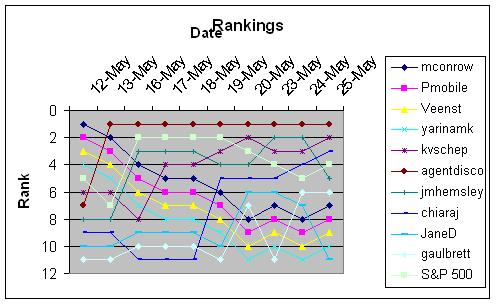
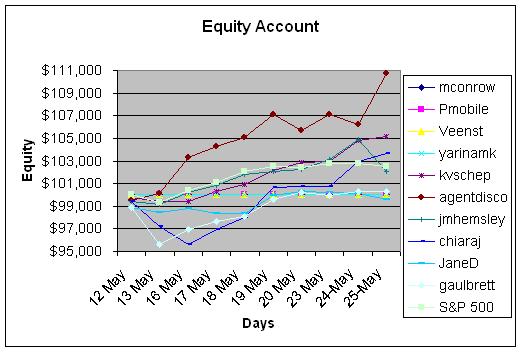
A lot of blood and sweat was lost over the last 3 weeks during the Cashtalk Stockmarket Contest. After the dust settled, Agentdisco is a resounding winner with over $117k of equity! Thanks everyone for playing. We'll be planning another contest for sometime in the future. Keep checking Cashtalk for details.
Also, if you are interested you can continue to follow your portfolios from this game, you just can't trade anymore.
Also, if you are interested you can continue to follow your portfolios from this game, you just can't trade anymore.


Calpine, take me away...
If anyone's been following the Investopedia game the last couple of weeks, you'll see that I bought and held shares of Calpine (CPN). To be honest, I didn't even know what they did when I bought the stock - it was purely a speculative play based on a news report on CNBC. The perfect example of an amateur-hour strategy everyone always advises against.
But I got a little bit lucky, and CPN's gains pretty much drove my portfolio higher all by themselves. Even after an initial bump last week, they shot up another 10% this Tuesday. I couldn't believe it. I've been busy and haven't had time to check into why they moved again, but today I found this article on smartmoney.com that explains everything very well.
It's a fairly short article, and an excellent example of some of the criteria analysts use to value a company.
But I got a little bit lucky, and CPN's gains pretty much drove my portfolio higher all by themselves. Even after an initial bump last week, they shot up another 10% this Tuesday. I couldn't believe it. I've been busy and haven't had time to check into why they moved again, but today I found this article on smartmoney.com that explains everything very well.
It's a fairly short article, and an excellent example of some of the criteria analysts use to value a company.
Friday, May 27, 2005
Land of Opportunity: More Millionaires Now than Ever
According to this article published in the WSJ Online, there are more millionaires now than ever before (7.5 million). I think that's great news and a testament to the ability of our country and economy to encourage entrepreneurship and growth. I especially like this quote:
Check it out.
A separate study, also released yesterday, by Boston Consulting Group found that the U.S. continues to lead the world in creating new millionaires. The number of households in the U.S. with liquid assets of $20 million or more is increasing by 3,000 households a year.Something else to ponder is the propensity of the wealthy to get that way by investing:
Households with net worth of $3 million or more garnered 34% of their wealth last year from investment gains, according to the Spectrem survey. Only 31% of their wealth last year came from compensation. The remainder came from privately owned businesses, inheritances and other sources.
Check it out.
Thursday, May 26, 2005
Ima Crook... or I. Steele Dough.... or:
Federal Trade Commission member Orson Swindle, one of three Republicans on the panel, will resign at the end of June. Mr. Swindle has been with the agency for more than seven years. The White House hasn't yet picked a replacement.
I don't know anything about this guy, but I had to laugh at an FTC member with that last name.
Looks like the markets are a little friendlier today. I sold my stake in MCZ - wasn't going anywhere. Rather have the cash, with no risk, if MCZ isn't at least going to give me a little volatility! Everything else is pretty much steady, although NGPS is giving back some of yesterday's gains. I got in on the tail end of Toll Brothers' 6% gain (tail end being 2%) after they reported stellar earnings and raised their outlook this morning. I've lost $ on DNA since I bought it, but I think it will bounce into positive territory if the market continues to rally. CPN has been very good to me - almost 25% gain since WEDNESDAY MORNING! That's it - that's all I own right now. Looking for one or two more winners tomorrow and Tuesday to close this game out. Got any ideas? Post 'em here.
I don't know anything about this guy, but I had to laugh at an FTC member with that last name.
Looks like the markets are a little friendlier today. I sold my stake in MCZ - wasn't going anywhere. Rather have the cash, with no risk, if MCZ isn't at least going to give me a little volatility! Everything else is pretty much steady, although NGPS is giving back some of yesterday's gains. I got in on the tail end of Toll Brothers' 6% gain (tail end being 2%) after they reported stellar earnings and raised their outlook this morning. I've lost $ on DNA since I bought it, but I think it will bounce into positive territory if the market continues to rally. CPN has been very good to me - almost 25% gain since WEDNESDAY MORNING! That's it - that's all I own right now. Looking for one or two more winners tomorrow and Tuesday to close this game out. Got any ideas? Post 'em here.
Wednesday, May 25, 2005

The "Trade Deficit" Explained
A great article by Walter Williams talks about what a trade deficit is. What we see in the news about a trade deficit with China or other foreign countries does not make economic sense. We buy goods from a company, we exchange money for those goods. We don't expect that company to buy something back from us to give us our money back, do we? It's the same principle on a national scale. Understanding accounting helps, and Mr. Williams has excellent examples to clarify his points. Read the article and see if it changes your mind about trade deficits!
Tuesday, May 24, 2005
Trump University: You'll learn more watching paint peel
Donald Trump is opening a "university" to bestow his jewels of wisdom on unsuspecting people who may actually believe he is a good business man. This article at the Fool has the details.
I might be coming off as being anti-education. Nothing could be further from the truth. I contribute to this site so that I can learn more about economics, business, and finance. I hope that by reading the site and also contributing, others will learn the same. I believe that education about money is the first step to being released from poverty and is a beginning to building wealth and changing, not only your own life, but your family's wealth and position for generations to come.
It really is amazing that by understanding something as simple as saving and investing can enable a person to retire wealthy and pass that wealth on to anyone they want. Everybody is capable. All it takes is education and a will to apply that education to the real world.
Unfortunately though, the quality of your information may not always be the highest. Donald Trump, while being a charismatic entrepreneur and an arguably crafty marketer, is not a very successful business person. I think an alternative place to learn about business is to read books about successful business and successful people. I'm currently listening to a book on CD called "Good to Great" by Jim Collins. Mr. Collins and his research team looked at "Great" companies and tried to discover what made them stand out from their peers. This is a great book with some relevant insights into ways to distinguish your own business or business practices from "the crowd." I encourage you to look into it. And if you don't, find a good book to begin learning, or expand your knowledge of the financial and business world around you.
I might be coming off as being anti-education. Nothing could be further from the truth. I contribute to this site so that I can learn more about economics, business, and finance. I hope that by reading the site and also contributing, others will learn the same. I believe that education about money is the first step to being released from poverty and is a beginning to building wealth and changing, not only your own life, but your family's wealth and position for generations to come.
It really is amazing that by understanding something as simple as saving and investing can enable a person to retire wealthy and pass that wealth on to anyone they want. Everybody is capable. All it takes is education and a will to apply that education to the real world.
Unfortunately though, the quality of your information may not always be the highest. Donald Trump, while being a charismatic entrepreneur and an arguably crafty marketer, is not a very successful business person. I think an alternative place to learn about business is to read books about successful business and successful people. I'm currently listening to a book on CD called "Good to Great" by Jim Collins. Mr. Collins and his research team looked at "Great" companies and tried to discover what made them stand out from their peers. This is a great book with some relevant insights into ways to distinguish your own business or business practices from "the crowd." I encourage you to look into it. And if you don't, find a good book to begin learning, or expand your knowledge of the financial and business world around you.
Subscribe to:
Posts (Atom)