Friday, May 27, 2005

Land of Opportunity: More Millionaires Now than Ever

According to this article published in the WSJ Online, there are more millionaires now than ever before (7.5 million). I think that's great news and a testament to the ability of our country and economy to encourage entrepreneurship and growth. I especially like this quote:
A separate study, also released yesterday, by Boston Consulting Group found that the U.S. continues to lead the world in creating new millionaires. The number of households in the U.S. with liquid assets of $20 million or more is increasing by 3,000 households a year.
Something else to ponder is the propensity of the wealthy to get that way by investing:
Households with net worth of $3 million or more garnered 34% of their wealth last year from investment gains, according to the Spectrem survey. Only 31% of their wealth last year came from compensation. The remainder came from privately owned businesses, inheritances and other sources.

Check it out.

Thursday, May 26, 2005

Ima Crook... or I. Steele Dough.... or:

Federal Trade Commission member Orson Swindle, one of three Republicans on the panel, will resign at the end of June. Mr. Swindle has been with the agency for more than seven years. The White House hasn't yet picked a replacement.

I don't know anything about this guy, but I had to laugh at an FTC member with that last name.

Looks like the markets are a little friendlier today. I sold my stake in MCZ - wasn't going anywhere. Rather have the cash, with no risk, if MCZ isn't at least going to give me a little volatility! Everything else is pretty much steady, although NGPS is giving back some of yesterday's gains. I got in on the tail end of Toll Brothers' 6% gain (tail end being 2%) after they reported stellar earnings and raised their outlook this morning. I've lost $ on DNA since I bought it, but I think it will bounce into positive territory if the market continues to rally. CPN has been very good to me - almost 25% gain since WEDNESDAY MORNING! That's it - that's all I own right now. Looking for one or two more winners tomorrow and Tuesday to close this game out. Got any ideas? Post 'em here.

Wednesday, May 25, 2005

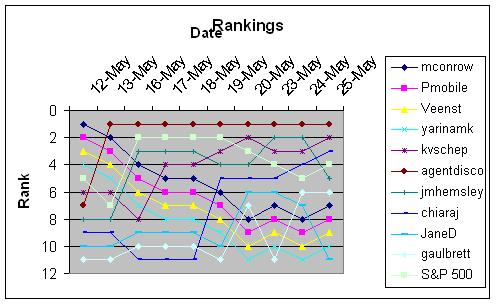
The current standings. I've added the S&P500 as a benchmark again. Somebody needs to knock AgentDisco down! :-) Posted by Hello
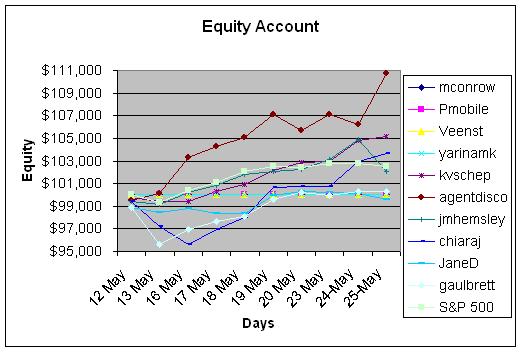
This was my worst day yet. If you read the Trump post from yesterday, you'll see that I've become Trump! AgentDisco on the other hand, is smokin'. Posted by Hello
May 25th Equity (Account) Standings from the Cashtalk Stockmarket Contest. I've added the S&P500 as a benchmark. On May 12th, if you would have invested $100,000 in an S&P500 mutual fund, today you'd have $102,472.  Posted by Hello

The "Trade Deficit" Explained

A great article by Walter Williams talks about what a trade deficit is. What we see in the news about a trade deficit with China or other foreign countries does not make economic sense. We buy goods from a company, we exchange money for those goods. We don't expect that company to buy something back from us to give us our money back, do we? It's the same principle on a national scale. Understanding accounting helps, and Mr. Williams has excellent examples to clarify his points. Read the article and see if it changes your mind about trade deficits!

Tuesday, May 24, 2005

Trump University: You'll learn more watching paint peel

Donald Trump is opening a "university" to bestow his jewels of wisdom on unsuspecting people who may actually believe he is a good business man. This article at the Fool has the details.

I might be coming off as being anti-education. Nothing could be further from the truth. I contribute to this site so that I can learn more about economics, business, and finance. I hope that by reading the site and also contributing, others will learn the same. I believe that education about money is the first step to being released from poverty and is a beginning to building wealth and changing, not only your own life, but your family's wealth and position for generations to come.

It really is amazing that by understanding something as simple as saving and investing can enable a person to retire wealthy and pass that wealth on to anyone they want. Everybody is capable. All it takes is education and a will to apply that education to the real world.

Unfortunately though, the quality of your information may not always be the highest. Donald Trump, while being a charismatic entrepreneur and an arguably crafty marketer, is not a very successful business person. I think an alternative place to learn about business is to read books about successful business and successful people. I'm currently listening to a book on CD called "Good to Great" by Jim Collins. Mr. Collins and his research team looked at "Great" companies and tried to discover what made them stand out from their peers. This is a great book with some relevant insights into ways to distinguish your own business or business practices from "the crowd." I encourage you to look into it. And if you don't, find a good book to begin learning, or expand your knowledge of the financial and business world around you.

Monday, May 23, 2005

Motor Homes (Winnebago) have a Good Year Despite Gas Prices

I decided to mention this because Winnebago is an Iowa product and a lot of people around here know about them. This is an interview with their CEO, Bruce Hertzke, on his own industry, how gas prices have affected them (not much) and their target market. Enjoy!

I can't believe the horrible mileage these things get, and how much they cost, brand new. Mr Hertzke does have a point, though, about the increasingly ageing baby boomers entering his target market.

Banks are Falling Over Themselves to Get You as a Customer

I just read this article at Smartmoney.com. Pretty interesting the extent to which these large banks are competing for customers. I think this is a great example of consumer power. When you have a large variety of competition, the consumer wins.

Personally, I don't care about weekend hours, free MP3 players, or "points." When I look for a bank, it's all about "Show me the money." Who has the highest savings and checking rates? That's right. I earn interest on all of my accounts. If my bank started doing this marketing stuff instead of paying interest rates, I'd leave in an instant.

That's the great thing about this, though. The banks are finding a customer they want to target, offering him/her something, and reeling them in. Ultimately, though, it's up to the customer to choose.

Friday, May 20, 2005

Should Americans Work Less Hours?

An interesting article from the Economist. It compares the working hours of Americans to their European counterparts and suggests that if everybody in America worked less, then we could be more productive or have better welfare? I'm skeptical. The article calls to attention the role of government intervention in these decisions. I myself would be highly skeptical of any moves the legislature might make to regulate a work week. I like the idea of employees and employers negotiating a work schedule based on their mutual interests. Read the article and let me know what you think.

(if you haven't subscribed to the Economist, check out the article in the comments section)
Here are the contest rankings as of May 20th. A lot of movement! Posted by Hello
These are the day-by-day percent gains and losses. The S&P500 is included as a reference. Posted by Hello
Here are the Equity standings as of close of business May 20th Posted by Hello

Thursday, May 19, 2005

The Competition is Close!

It looks like the wide losses people were experiencing at the beginning of last week are beginning to narrow significantly. Tomorrow, I'll post some more graphs.

My strategy has changed significantly. I've sold most of the stocks that were not performing well and have begun to buy stocks that really show signs of moving. So far, it hasn't worked out great, but we'll see how this ends up on May 31st!

I'd love to hear how others are doing. Leave a comment!

Wednesday, May 18, 2005

A Vacationer's Tale

I'm heading out of town for a few days on vacation. It's been almost six months since my last vacation which, for me, seems like an extremely long time. I can't wait until "vacation" is what I do most of the time, and I have to work as infrequently as I currently rest. Until then, I will make the most of the next few days.

That means I won't have my eyes and ears glued to the market, although I may check in from time to time. With the unpredictable and volatile nature of the recent market, I don't want to risk coming home to find my portfolio in this game wiped out. I don't even want to drop a couple of percentage points, which can make the difference between top-of-the-pile and bottom-of-the-pile in this game. On the other hand, since 3 out of 4 stocks follow the general direction of the market, if yesterday's rally is the start of something - I don't want to miss out on some gains.

So, my "vacationer's strategy": put in sell stop orders for 1% below yesterday's closing price. If one of my holdings drops 1% from Tuesday's closing price, it sells automatically, thus limiting my downside exposure. But, if stocks rally, I get to take advantage of the upside gains. Not a perfect strategy (a stock could drop 1% in the morning and, after I automatically sell it, it gains 2-3% in the afternoon) - but better than crossing my fingers.

See ya Monday.

Tuesday, May 17, 2005

Stock Market Contest Rankings

These are the rankings since I began to keep track on May 12th. Posted by Hello
This is the daily Percentage gained or lost during each day. I've included the S&P 500 as a comparison. Posted by Hello
This graph shows the rankings based on how much equity each of the players has accumulated (or lost) since May 12. Posted by Hello

The Albatross Around My Neck is Gone and Now It's Working for Me

Yesterday I sold Ford. It is now somebody else's problem. I first sold 750 shares at a 3.20% loss and then another 250 at a 3.75% loss. I took advantage of its higher price yesterday and unloaded.

But then an idea struck me. Why can't I make Ford's poor performance work for me? The stock market has many options for trading, not just buying and selling. What I decided to do was "Short Sell" Ford. What this means is I borrowed money from the broker by "selling" Ford at yesterday's price. Ideally, for this strategy to work, Ford would drop in price (and if you've been reading my other posts, you know it has been), and then I would "buy" or cover the loan by buying the stock back at a lower price. Currently, using this strategy, I'm making a 1.69% profit. As long as Ford keeps dropping, I'll continue to make money, until I decide to repay the loan.

In the meantime, with the money I was loaned by shorting Ford, I bought Adobe Systems, Inc. and Target. As of today, both are doing well.

In other news, the Electronic Entertainment Expo begins today. If you own gaming, entertainment, or electronic hardware stocks, the odds are your stocks are going to rise today. Sony announced their new PS3 system and Microsoft has announced the next generation of the Xbox. Any company that does business with these two, will likely see a jump in their expected returns and hence their stock price.

I'd love to hear from others in the stock market contest. Instructions for initiating a post can be found here.

Later today, I'll post the standings of the Cashtalk stockmarket contest. Keep checking back!

Monday, May 16, 2005

PART II - The Future Value (FV) of money and Discounted Cash Flows

Last week, we talked about the Present Value of money and worked a very simple problem to determine how much a single cash flow from the future would be worth today. If you missed that simple review, you can find it here.

Today we are going to learn how to calculate the value of money you have today and find out how much it would be worth in the future if you saved it or invested it. This value is called the Future Value (FV) of money.

This is actually a very simple equation. You take the money you have today (PV or C0) and multiply it by the interest rate ( r ) and add 1:

FV = PV * ( 1 + r )

This equation gives you the Future Value of an amount of money for some period of time. Let’s plug in some numbers and see what we get. Let’s say we have $1,000 and would like to put it in a bank that offers an annual 3.25% interest rate. How much will it be worth in a year?

FV = $1,000 * ( 1 + .0325) = $1,032.50

If you saved $1,000 in a bank, in a year it would be worth $1,032.50. This is fairly simple. Where this simple equation, in addition to the PV equation, becomes quite useful is when you are trying to determine the values of a number of different cash flows.

This leads us to a discussion on finding the Present Value (PV) and Future Values (FV) of multiple cash flows. Let’s return to the PV equation:

PV = C1 / (1 + r )

This equation tells us how much a cash flow one period from now (from now on we’ll assume a period = a year for simplicity sake, but really C1 stands for a cash flow in period 1) will be worth today. Suppose we want to know the value of a cash flow 2 years from now? We would have to discount the interest rate ( r ) by the additional year. So you would get this equation, where C2 is the Year 2 cash flow and the exponent “2” represents the annual interest rate invested over two years:

PV = C2 / (1 + r )^2

Let’s use some real numbers to see how this plays out. If I were to receive $22,000 two years from now, and I could invest that amount in a mutual fund today that has traditionally earned 10% (the opportunity cost of not having the money today), what is that $22,000 worth today?

PV = $22,000 / (1.1)2 = $18,181.82

Now let’s figure out how much a string of cash flows would be worth. Let’s say someone is giving you a business that for 4 years will pay you $3,000 in profits (if only we were all so lucky) every year. How could you find out how much that is worth? Well you can figure out how much each of the cash flows would be worth in its specific year and then add them together. We’ll assume that we could put the money in the bank today and get 3.25% interest. The equation for this example would look like this:

PV = [$3,000 / (1.0325)] + [$3,000 / (1.0325)^2] + [$3,000 / (1.0325)^3] + [$3,000 / (1.0325)^4] = $11,084.95

The value of the business today is $11,084.95. Pretty simple right? Well, there is actually a short cut equation that you can use to find the PV of a string of cash flows which are the same. The equation looks like this:

PV = (C / r ) * [ 1 – 1 / (1 + r)^n]

Or for FV it looks like this:

FV = (C / r ) * [{(1 + r)^n} – 1]

These are called annuities. By using algebra, you can solve for parts of the equations to answer questions about money. Let’s use them to figure out how much money I need to save to retire. If I wanted to have a million dollars when I retire (in 30 years) and I knew I could get 10% in a mutual fund starting today, how much money should I contribute a year?

FV = $1,000,000
r = 10%
n = 30

$1,000,000 = (C / 0.1)*[{(1.1)^30} – 1] =

I would have to contribute $6,079.25 a year to have $1,000,000 in 30 years at 10% interest.

Plug your own numbers in. Need to know how much interest you’re paying on your car loan? Plug it in:

You make $375 monthly payments (C) on a $15,000 (PV) car for the next 4 years (n/12). Just solve for r:

$15,000 = ($375/r)*[1 – 1/(1+r)^48]

In this particular problem, you’re monthly interest rate would be 0.77015%. This would compound to an APR of about 9.242%. There you have it. This is the power of the time value of money. If you have any questions, please leave a comment. There will more to come!